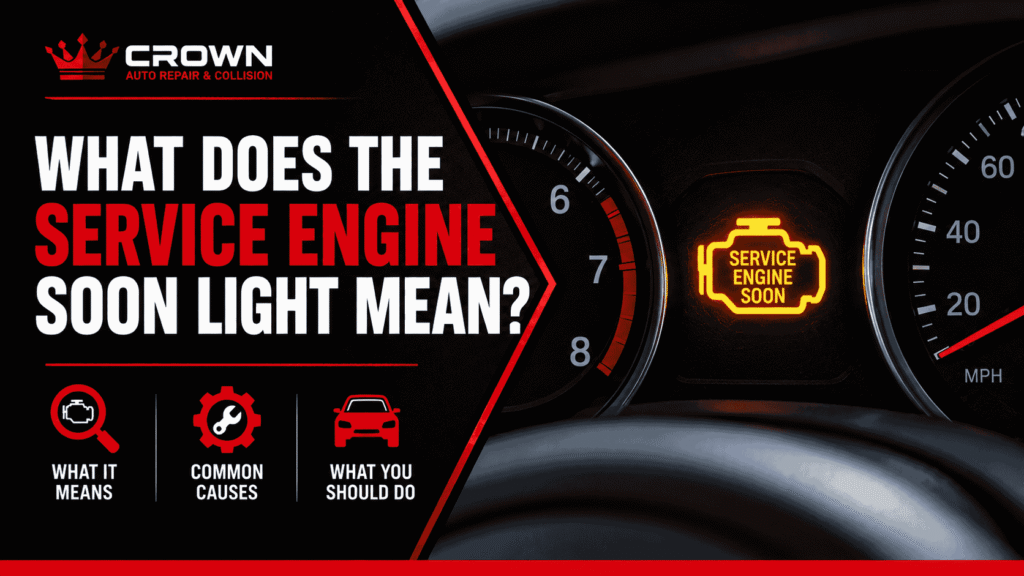
You’re driving down US-59 in Sugar Land. The AC is blasting, the radio is on, and then a small orange light pops up on your dashboard: “Service Engine Soon.”
Your stomach drops. Is the engine about to die? Will the repair cost thousands? Can you still make it home?
Take a breath. Most of the time, this light is a warning, not a disaster. But it is also not something to ignore. It’s your car’s way of saying, “Something needs a look, and sooner is better.”
This guide explains what the Service Engine Soon light means in plain English. You’ll learn the common causes, whether you can keep driving, and what to do next. We’ll also cover the Texas details that matter to drivers in Sugar Land, Houston, and across the state.
Table of Contents
ToggleWhat Does the Service Engine Soon Light Mean?
The Service Engine Soon light means your car’s computer found a problem with the engine, the emissions system, or a related part, and it wants you to get the car checked soon.
Your car has a built-in system called OBD-II (On-Board Diagnostics). Think of it as a team of tiny reporters watching your engine, exhaust, fuel system, and more. These reporters are sensors. When a sensor sends a reading that looks wrong, the computer saves a trouble code and turns on the light.
Here’s the key point: the light tells you something is wrong, but not what. It could be as small as a loose gas cap or as serious as an engine misfire. A scan and a proper inspection tell you which one it is.
Service Engine Soon vs. Check Engine Light: Is There a Difference?
Short answer: no, not in meaning. They are two names for the same warning.
Different carmakers use different wording:
- Some vehicles, especially older Fords, GMs, and some BMWs, display the words “Service Engine Soon.”
- Many newer cars show a “Check Engine” message or a small engine-shaped icon.
- Some brands use extra lights, like a wrench or an EPC (Electronic Power Control) light, for related problems.
All of them connect to the same system and the same set of trouble codes. If you want a deeper look at the most common triggers, our guide on common check engine light issues walks through them one by one.
The wording is not what matters. How the light behaves is what matters. That brings us to the biggest question.
Solid vs. Flashing Service Engine Soon Light
Solid (Steady) Light | Flashing (Blinking) Light | |
What it means | A problem was detected | A serious problem is happening now |
Urgency | Get it checked within days | Stop driving as soon as it’s safe |
Common causes | Loose gas cap, sensor trouble, small leaks | Engine misfire, fuel or ignition failure |
Risk if ignored | Poor mileage, failed emissions test, bigger repairs | Catalytic converter damage, engine damage |
What to do | Schedule a diagnostic soon | Pull over, turn off the engine, call a pro |
What a Solid Light Means
A steady light means the computer found a fault, but it is not an emergency. The car may feel normal. Many drivers keep driving for weeks because “it seems fine.” That is a mistake. Small problems can quietly grow into expensive ones.
What a Flashing Light Means
A flashing light means act now. It usually points to an engine misfire. Raw, unburned fuel is being dumped into the exhaust. That fuel can overheat and ruin your catalytic converter, which is one of the costliest parts to replace.
If your light flashes, ease off the gas, pull over safely, and shut the car off. Don’t try to “push through” the last few miles.
Common Causes of the Service Engine Soon Light
Dozens of things can turn this light on. Here are the ones we see most often, along with what usually fixes them.
1. Loose or Damaged Gas Cap
This is the easiest fix. A loose, cracked, or missing cap lets fuel vapor escape and upsets the fuel system’s pressure.
Fix: Tighten the cap until it clicks. A new cap often costs under $30.
Risk: Low, but it hurts fuel economy and can trigger an emissions failure.
2. Faulty Oxygen Sensor
Oxygen sensors measure how much unburned oxygen is in your exhaust. A worn one confuses the computer, which then burns too much or too little fuel.
Fix: Replace the sensor.
Risk: Worse gas mileage and a possible damaged catalytic converter over time.
3. Worn Spark Plugs or Bad Ignition Coils
These parts light the fuel in your engine. When they wear out, the engine misfires. You may feel shaking, hesitation, or rough idling.
Fix: Replace the plugs or coils.
Risk: A misfire can turn a solid light into a flashing light fast.
4. Failing Catalytic Converter
The catalytic converter cleans harmful gases from your exhaust. It often fails because another problem, like a misfire, was ignored.
Fix: Usually replacement, which can run well over $1,000 for many vehicles.
Risk: Failed emissions test, poor power, and a rotten-egg smell.
5. Mass Airflow (MAF) Sensor Problems
This sensor measures the air entering your engine. If it’s dirty or broken, the fuel mix goes off.
Fix: Cleaning or replacement.
Risk: Rough running, stalling, and wasted fuel.
6. EVAP System Leaks
The EVAP system traps fuel vapors so they don’t escape into the air. A cracked hose or faulty valve can trigger the light. Shops use a smoke machine to find tiny leaks you’d never spot yourself. If this is the cause, EVAP and emissions repair in Sugar Land can track down the leak and get the light cleared properly.
7. Weak Battery or Charging Problems
A battery or alternator on its way out can send odd voltage signals that confuse the computer. Texas heat is hard on batteries, so this one is common here.
8. Transmission or Sensor Faults
Some transmission faults also trigger the engine light. If you notice slipping, delayed shifting, or harsh gear changes, transmission repair and service may be what your car needs.
9. Recent Repairs or Part Replacements
Sometimes the light appears after a new part is installed, because the car’s computer needs to be told how to work with it. This is where car coding and programming comes in.
Can You Drive With the Service Engine Soon Light On?
This is one of the most searched questions about the topic, so here’s a simple answer.
Solid light, car feels normal: You can usually drive for a short time, but get it checked within a few days. Don’t wait weeks.
Solid light, car feels “off”: If you notice shaking, loss of power, strange smells, or poor acceleration, don’t wait. Get it checked as soon as you can.
Flashing light: Pull over safely and stop. Driving on a flashing light risks serious engine and exhaust damage.
Light plus other warnings: If the light comes on with an oil pressure light, a temperature warning, or smoke, stop driving right away and call for help.
A few extra tips:
- In Houston-area heat, an overheating engine can fail fast. Don’t gamble when the temperature gauge climbs.
- Avoid long trips, towing, or hard driving until the car has been checked.
- If you’re unsure, a quick call to a trusted shop can save you from a bad guess.
How to Diagnose a Service Engine Soon Light
You don’t need to be a mechanic to take the first steps. Here is a simple routine.
- Check the gas cap. Remove it, reinstall it, and turn until it clicks. The light may take a few drives to go away.
- Notice how the car feels. Is it shaking, hesitating, or using more gas? Write it down. These clues help a technician.
- Check for obvious signs. Look for smoke, strange smells, or fluid under the car.
- Read the codes. An OBD-II scanner plugs in under the dashboard and displays trouble codes. Many auto parts stores can read basic codes.
- Understand what a code does and doesn’t tell you. A code like P0420 points to the catalytic converter system, but the cause could be the converter, an oxygen sensor, or an exhaust leak. A code tells you where to look, not which part to buy.
- Get a full diagnostic. A professional scan, plus a hands-on inspection, finds the real root cause. This step prevents “parts swapping,” where you pay for repairs that don’t fix anything.
Pro tip: Don’t just clear the code and hope. Clearing it erases helpful data and the problem will usually return.
What Happens When the Service Engine Soon Light Turns Off?
Sometimes the light goes away on its own. That feels like good news, but it isn’t always. Here’s what may be happening.
- The problem fixed itself. A loose gas cap that you tightened, for example. The computer may need several driving trips to confirm everything is normal before it turns the light off.
- The problem is intermittent. Some faults come and go. The light shuts off, but the fault is still there and will likely return.
- The code is still stored. Even if the light is off, the computer may keep a record of the fault. A technician can read it.
- Someone reset the system. Disconnecting the battery or clearing codes turns the light off but doesn’t repair anything. It also resets the car’s “readiness monitors,” which can make you fail an emissions test until the car has been driven enough.
Bottom line: A light that turns off is a good sign, but it’s not a green light to forget about it. If it came on once, have it checked.
Vehicle-Specific Differences Drivers Should Know
Not every car handles this warning the same way. Here are some common differences.
- Ford and GM vehicles: Many show the words “Service Engine Soon.” Ford trucks may also show a wrench icon when there’s a powertrain problem that can limit power.
- Toyota, Honda, and many imports: These often use the engine icon or a “Check Engine” message instead of the words.
- German brands (BMW, Mercedes, VW, Audi): These often add a text message or extra lights, such as an EPC light on some VW models. Their systems are sensitive, and codes can be more detailed.
- Diesel trucks: Popular across Texas, diesels may show extra lights for glow plugs, emissions fluid, or particulate filters, along with the engine warning.
- Hybrids and newer vehicles: These may have multiple software-driven warnings. A scan tool made for your exact vehicle matters more here.
Because each system speaks a slightly different “language,” a shop with the right tools and training for your make and model gives you a more accurate answer.
Why This Matters in Sugar Land, Houston, and Across Texas
Texas drivers face a few special conditions that make this light worth taking seriously.
Heat and humidity. Long, hot summers put stress on batteries, cooling systems, sensors, and rubber hoses. Heat can speed up wear, and failing parts trigger the light more often.
Stop-and-go traffic. Commutes on US-59, Highway 6, and the Sam Houston Tollway mean lots of idling and short trips. This is hard on spark plugs, oxygen sensors, and the exhaust system.
Flood-affected vehicles. Houston-area storms and flooding can leave moisture in electrical connectors and sensors. Electrical gremlins and warning lights can show up weeks later.
Emissions testing. Texas still requires emissions testing in a number of metro counties, including the Houston area (Harris and Fort Bend counties), Dallas-Fort Worth, Austin, and El Paso. A lit Service Engine Soon light generally means your car will not pass. Rules and requirements can change, so check the official Texas DPS or state vehicle inspection website for the latest details before your renewal.
Whether you live in Sugar Land, Katy, Austin, or San Antonio, the lesson is the same: a lit warning light can stand between you and your registration renewal.
What Are the Risks of Ignoring the Light?
Putting off a diagnostic is tempting, especially when the car “seems fine.” Here is what can happen:
- Lower gas mileage. Many faults make the engine burn more fuel than it should.
- Bigger repair bills. A $60 sensor can become a $1,500 catalytic converter job.
- Failed emissions test. You can’t renew your registration with a failing result in testing areas.
- Breakdown risk. A small fault can leave you stranded on the freeway.
- Safety concerns. Power loss while merging or climbing an overpass can be dangerous.
- Lower resale value. A car with ongoing warning lights is harder to sell.
Fixing the problem early is almost always cheaper and less stressful.
When to Visit a Repair Shop
Don’t wait if you notice any of these:
- The light is flashing
- The light stays on for more than a few days
- The car shakes, stalls, or loses power
- You smell gas, rotten eggs, or burning
- The light comes on with an oil, temperature, or battery warning
- You see smoke from the hood or exhaust
- Your gas mileage suddenly drops
- Your emissions test or registration renewal is coming up
If your Service Engine Soon Light is on and you’re not sure how serious it is, a quick diagnostic is the smartest next step. It takes the guessing out and lets you decide with real information.
If the diagnosis points to the engine itself, professional engine repair in Sugar Land can handle everything from sensors to deeper mechanical issues. Staying on top of your oil change schedule also helps keep your engine healthy and can head off some warning lights before they start.
Choosing the Right Shop in Sugar Land
Not all diagnostics are equal. A cheap code scan only reads a number. A good shop confirms the real cause so you don’t pay twice. Look for:
- Certified technicians (such as ASE-certified)
- Modern diagnostic equipment
- Clear explanations in plain language
- A written estimate before work begins
- A warranty on parts and labor
If you’re comparing options, our local guide to the best auto repair shops in Sugar Land can help you know what to look for.
Get Your Service Engine Soon Light Checked at Crown Auto Repair & Collision
Seeing a warning light shouldn’t leave you worried about the bill or the truth. At Crown Auto Repair & Collision in Sugar Land, our ASE-certified technicians use advanced diagnostic tools to find the real cause of your Service Engine Soon light, explain it in plain words, and fix it right. We work on domestic, Asian, and European vehicles, and our engine repairs come with a 12-month / 12,000-mile warranty on parts and labor.
Don’t let a small light turn into a big repair.
📞 Call (832) 295-3424 to book your diagnostic today.
📍 Crown Auto Repair & Collision, 16002 Old Richmond Rd, Sugar Land, TX 77498
🕒 Hours: Monday–Friday 8 AM–6 PM, Saturday 8 AM–2 PM
Whether you’re in Sugar Land, Missouri City, Houston, or anywhere across the Greater Houston area, we’re ready to help you get back on the road with confidence.
Frequently Asked Questions About the Service Engine Soon Light
What does the Service Engine Soon light mean?
It means your car’s computer detected a problem in the engine, emissions, or a related system. The cause can be minor, like a loose gas cap, or serious, like a misfire. A diagnostic scan finds the exact reason.
Is Service Engine Soon the same as the check engine light?
Yes. They are the same warning with different names. Different car brands use different wording, but both mean the computer has stored a trouble code.
Can I drive with the Service Engine Soon light on?
If the light is solid and the car runs normally, you can usually drive a short time, but get it checked within a few days. If it’s flashing, pull over safely and stop driving.
Why is my Service Engine Soon light flashing?
A flashing light usually signals an engine misfire. Unburned fuel can overheat and damage the catalytic converter. Stop driving as soon as it’s safe and have the car towed or inspected.
How long can I drive with the Service Engine Soon light on?
There’s no safe number of days. A solid light with no symptoms may allow a few days of careful driving, but the longer you wait, the higher the risk of a bigger repair.
Can a loose gas cap cause the Service Engine Soon light?
Yes. A loose, cracked, or missing gas cap is one of the most common causes. Tighten it until it clicks. If the light stays on after a few days of driving, get a scan.
Will the Service Engine Soon light go off by itself?
Sometimes. If the problem was temporary, the light may turn off after several normal driving trips. But the fault may still be stored in the computer and could return, so a check is still smart.
Will my car pass inspection with the light on?
In Texas emissions-testing counties, a lit warning light usually means your car will fail the emissions portion. Fix the cause first, then retest. Check the official Texas inspection requirements for your county.
How much does it cost to fix a Service Engine Soon light?
It depends on the cause. A gas cap may cost under $30, a sensor may cost more, and a catalytic converter can cost over $1,000. A diagnostic shows exactly what you need before you spend a dollar on repairs.
Can I reset the light myself?
You can clear codes with a scanner or by disconnecting the battery, but that only hides the problem. The light will usually return, and you may fail an emissions test because the car’s readiness monitors reset.
Where can I get my Service Engine Soon light checked in Sugar Land?
Crown Auto Repair & Collision at 16002 Old Richmond Rd offers diagnostics and repairs for engine warning lights. Call (832) 295-3424 to schedule.
Final Thoughts
The Service Engine Soon light is not a reason to panic, but it is a reason to act. A solid light is a “get this checked soon” message. A flashing light is a “stop now” message. And a light that turns off doesn’t always mean the problem is gone.
The best move is simple: don’t guess, get it diagnosed. A small repair today is almost always cheaper than a big one next month.
Ready for answers? Call Crown Auto Repair & Collision at (832) 295-3424 and let our team find the cause and get you back on the road safely.