Table of Contents
ToggleThe Problem No Texas Driver Wants to Experience
You’re cruising down I-10 heading through Sugar Land toward Houston, the AC blasting, your favorite playlist on, and suddenly—jerk. Your car lurches forward unexpectedly. Your heart skips a beat. You grip the steering wheel tighter.
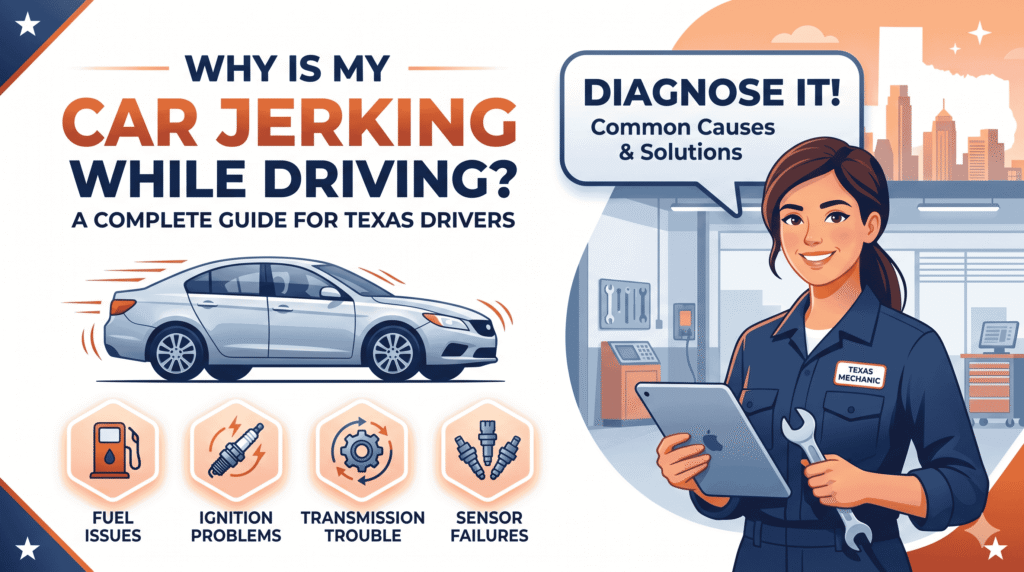
If this sounds familiar, you’re not alone. Every day, drivers across Texas call us at Crown Auto Repair & Collision asking the same desperate question: “Why is my car jerking while driving?”
That unsettling feeling isn’t just annoying—it’s your vehicle’s way of screaming for help. And the good news? In most cases, the problem is fixable. The better news? Understanding what’s happening can save you thousands of dollars in repairs and keep you safe on Texas roads.
Let me be straight with you: ignoring a jerking car is like ignoring a check engine light. It won’t go away on its own. In fact, it usually gets worse. But don’t panic. We’ve helped hundreds of Texas drivers diagnose and fix this exact problem. After 20+ years working on vehicles across the state, from the Gulf Coast to the Panhandle, I can tell you exactly what’s causing your car’s jerking and what you need to do about it.
What Exactly Is Car Jerking? (And Why Your Car Does It)
Before we dive into solutions, let’s define the problem clearly.
Car jerking while driving is when your vehicle experiences sudden, involuntary movements that feel like:
- Your car is skipping or hesitating during acceleration
- The engine is hiccupping as you press the gas pedal
- You’re getting small, repeated jolts even at constant speeds
- Your car is jumping or lurching without warning
This isn’t the same as rough idling (which happens when you’re parked) or a transmission clunk (which you feel when shifting gears). When your car jerks while driving, it’s happening during movement, usually unpredictably.
Why Does This Happen?
Your car’s engine is essentially a controlled explosion happening thousands of times per minute. When everything works correctly, that explosion happens with perfect timing, and you get smooth acceleration. But when something’s off—even slightly—the rhythm breaks. Instead of one smooth wave of power, you get stutters, skips, and jerks.
Think of it like a musical metronome. When it’s working, every beat lands perfectly on time. But if something’s broken inside? Now you’re getting random beats, missed beats, or delayed beats. Your car’s engine feels the same way to your body.
7 Reasons Why Your Car Is Jerking When Accelerating (And How to Fix Each One)
1. Spark Plugs That Have Seen Better Days
The Problem: Your spark plugs are responsible for igniting the fuel in your engine. When they’re worn out, fouled, or have the wrong gap distance, they can’t create a consistent spark. This causes your engine to misfire.
What it feels like: Jerking when you accelerate, especially noticeable when driving uphill or merging onto the highway.
The Fix: Spark plugs are one of the most common causes we see at our shop, and thankfully, one of the easiest to fix. Most cars need new spark plugs every 30,000 to 100,000 miles, depending on the type. If you’re experiencing jerking and your vehicle has more than 50,000 miles since the last plug change, this is likely your culprit.
Cost: $100–$300 for most vehicles DIY Friendly: Yes, if you’re mechanically inclined
2. A Clogged Fuel Injector
The Problem: Your fuel injectors spray tiny amounts of gasoline into the engine at precise moments. Over time, carbon deposits can clog them. When an injector can’t spray properly, some cylinders get too much fuel while others get too little.
What it feels like: Jerking when accelerating, rough acceleration, or your car hesitating before taking off.
The Fix: We usually recommend fuel system cleaning first—a chemical cleaner that flows through your fuel lines and helps dissolve deposits. If that doesn’t work, we may need to remove and professionally clean the injectors or replace them.
Cost: $50–$200 for cleaning; $250–$800 per injector replacement DIY Friendly: No—this requires specialized equipment
3. Your Transmission Is Slipping
The Problem: Automatic transmissions use fluid and friction to transfer power from your engine to your wheels. If your transmission fluid is low, dirty, or the clutches inside are wearing out, the transmission can’t engage smoothly.
What it feels like: Your car jerks when you accelerate, but it might also feel like the engine is revving but the car isn’t moving as fast as it should. You might also notice your car is jumping when driving at constant speeds.
The Fix: First, check your transmission fluid. It should be bright red and smell slightly sweet. If it’s dark brown or smells burned, it needs changing. If the fluid is fine, the problem is internal wear—this usually requires a transmission specialist.
Cost: $100–$300 for fluid change; $1,500–$4,000+ for internal repairs DIY Friendly: Checking the fluid—yes. Repairs—no.
4. Engine Knock Sensor Failure
The Problem: Your knock sensor detects when fuel is detonating too early inside the engine (engine knock). When it fails, your engine can’t adjust the timing properly, causing misfires.
What it feels like: Jerking during acceleration, especially when climbing hills. You might also hear a pinging or knocking sound from the engine.
The Fix: A scan with a diagnostic computer will reveal if the knock sensor has failed. Replacement is straightforward, and your jerking should stop immediately.
Cost: $150–$400 DIY Friendly: Moderate—depends on your vehicle’s layout
5. Vacuum Leak
The Problem: Your engine has a series of rubber hoses that create vacuum to help run various systems. A small crack in these hoses can cause air to enter where it shouldn’t, throwing off your air-fuel mixture.
What it feels like: Jerking, especially at lower speeds or when idling. You might also notice your check engine light is on.
The Fix: We listen for a hissing sound around the engine and use smoke tests to locate the leak. Most vacuum leaks can be fixed by replacing a hose, which is inexpensive.
Cost: $50–$200 DIY Friendly: Yes, if you can locate the leak
6. Dirty or Faulty Mass Air Flow (MAF) Sensor
The Problem: Your MAF sensor tells your engine how much air is coming in. This information helps the computer decide how much fuel to inject. When it’s dirty or broken, your air-fuel mixture becomes incorrect.
What it feels like: Car jerking when accelerating, hesitation, rough idling, and poor fuel economy.
The Fix: Try cleaning it first with MAF sensor cleaner (available at any auto parts store). If cleaning doesn’t work, it needs replacement.
Cost: $50–$100 for cleaning; $300–$500 for replacement DIY Friendly: Yes for cleaning; moderate for replacement
7. Bad Engine Control Unit (ECU) or Software Issues
The Problem: Your car’s computer controls everything. If it has a glitch or needs a software update, it can cause jerking.
What it feels like: Jerking randomly, sometimes at all speeds. The check engine light is usually on.
The Fix: We scan the vehicle with advanced diagnostic equipment. Often, a software update solves the problem. If the ECU is truly faulty, it needs replacement.
Cost: $0–$100 for software update; $500–$1,500 for ECU replacement DIY Friendly: No—requires professional diagnostic equipment
Why You Shouldn’t Ignore a Jerking Car: Real Risks in Texas
Let me paint you a picture. Sarah, a Houston accountant, noticed her car was skipping when accelerating on the Westpark Tollway. She thought, “It’ll probably fix itself. I’m too busy.”
Two weeks later, her car completely died on the Gulf Freeway during rush hour. An ignored vacuum leak had caused complete engine failure. The repair bill? $4,500. Her stress level? Immeasurable.
Here’s what happens when you ignore jerking:
Immediate Risks:
- Loss of power while driving (dangerous on highways)
- Difficulty merging or accelerating in emergency situations
- Potential stalling at stoplights or intersections
Long-Term Damage:
- Your catalytic converter gets damaged (could cost $500–$1,500 to replace)
- Engine damage from misfires (could run you $2,000–$5,000+)
- Transmission failure (could cost $3,000–$6,000+)
- Complete engine seizure
Why This Matters in Texas Specifically: Texas has extreme heat and heavy traffic. I-45, I-10, and the Beltway see intense daily congestion. When your engine is misfiring, it runs hotter. In our Texas summer temperatures (regularly 95°F+), this accelerates damage. Add stop-and-go traffic to the equation, and your jerking car becomes dangerous.
Quick Diagnostic: Is Your Car Jerking When You Accelerate?
Let me help you narrow this down:
My car jerks primarily when I accelerate → Likely spark plugs, fuel injectors, or MAF sensor
My car jerks at constant speeds → Likely transmission, engine knock sensor, or ECU
My car is jumping when driving AND jerks when accelerating → Likely transmission issue
My car skips when accelerating but feels fine otherwise → Likely fuel system or spark plugs
My car keeps jerking randomly → Likely vacuum leak or ECU issue
Pro Tip: Turn on your hazard lights and safely pull over. Does your check engine light come on? This gives us a huge clue. At Crown Auto Repair & Collision, we offer free computer diagnostics. We can scan your vehicle in 10 minutes and tell you exactly what’s wrong.
What Does It Mean When Your Car Jerks While Driving? The Bottom Line
It means something in your engine’s fuel, air, spark, or transmission system isn’t working right. The longer you wait, the more expensive it becomes.
I’ve seen cars that could have been fixed for $150 end up costing owners $2,000 because they waited three months. Don’t be that person.
Related Issues You Should Know About
Why Does My Car Jerk When I Start It?
If your car jerks when starting specifically, check out our complete guide on car shakes when parked. This is usually a spark plug or fuel pressure issue and is often easier to fix than mid-drive jerking.
Why Does My Car Jerk When I Accelerate vs. When Cruising?
Acceleration jerking points to fuel or ignition issues. Cruising jerking points to transmission or sensor problems. Our guide on car shake when i accelerate breaks down these differences.
Could This Be an Engine Repair Issue?
If you’ve ruled out fuel injectors and spark plugs, you might have an internal engine problem. Learn more in our full Engine Repair Service breakdown.
FAQ: What Texas Drivers Are Really Asking About Car Jerking
Q: Is it safe to drive a car that’s jerking?
A: Short distances? Usually yes. Long distances or highways? No. Get it diagnosed professionally. If you experience power loss or complete misfires, don’t drive it.
Q: How much will it cost to fix my jerking car?
A: Anywhere from $50 (vacuum hose) to $4,000+ (transmission repair). That’s why diagnosis matters. Most jerking issues run $100–$500.
Q: Can a faulty transmission cause jerking?
A: Yes. Transmission slipping feels like jerking. If your car jerks AND doesn’t accelerate like it should, get the transmission fluid checked immediately.
Q: Will my car’s jerking get worse over time?
A: Usually, yes. We rarely see a problem fix itself. Every mile you drive makes the damage worse.
Q: Is a jerking car a sign of a dying engine?
A: Not necessarily. But if you ignore it long enough, it could be. Most jerking issues are caught and fixed before engine damage occurs.
Q: What should I do first if my car starts jerking?
A: Safe place to pull over, turn off the engine, and call a mechanic. Get a proper diagnostic before you spend money guessing at the problem.
Q: Why is my car skipping when I accelerate specifically?
A: Skipping usually means your spark plugs aren’t firing consistently or your fuel injectors are clogged. We address this in detail in our fuel system guides.
Q: Does my check engine light mean my car is seriously broken?
A: Not necessarily, but it’s definitely worth investigating. The light comes on for hundreds of reasons. That’s what diagnostics are for.
How Crown Auto Repair & Collision Diagnoses Your Jerking Car
Here’s what we do differently at our Sugar Land and Houston locations:
- Free Computer Diagnostic (10 minutes) — We scan your vehicle and pull the exact error codes
- Physical Inspection — We check spark plugs, fuel injectors, transmission fluid, and sensors
- Test Drive — We drive your car to feel the jerking firsthand and confirm the issue
- Written Explanation — You get a clear report explaining what’s wrong and what repair options exist
- Honest Pricing — We fix only what’s broken, not what might be broken someday
No surprises. No upsells. No vague explanations.
Don’t Let Your Car Keep Jerking—Get Help Today
Here’s the truth: Your car is trying to tell you something. That jerking feeling is a warning light. And warnings have an expiration date.
Every day you drive a jerking car, you’re:
- Damaging your engine further
- Putting yourself at risk on Texas highways
- Turning a $200 fix into a $2,000 disaster
You wouldn’t ignore chest pain from your doctor. Don’t ignore warning signs from your car.
The good news? Nine times out of ten, your jerking car can be fixed quickly, affordably, and completely.
Schedule Your Free Diagnostic Today
- Phone: (832) 295-3424
- Service Areas: Sugar Land, Houston, and throughout Texas
- Hours: Monday–Friday, 8 AM–6 PM; Saturday, 9 AM–2 PM
- What to Expect: 10-minute free diagnostic, honest assessment, no pressure
Don’t spend another day worrying about whether it’s safe to drive. Call us today. Let’s get your car running smooth again.
Final Thoughts: You Know Your Car Better Than Anyone
You’ve been the one sitting in that driver’s seat, feeling every jerk and hesitation. You know something’s wrong. Trust that instinct.
Whether it’s a simple spark plug replacement or something more complex, getting it checked is the smartest decision you can make. And the sooner you get it done, the less damage you’ll have to pay for.
Your car deserves professional care. You deserve peace of mind.
Call Crown Auto Repair & Collision at (832) 295-3424 and let’s get you back to smooth, confident driving.