
Table of Contents
ToggleYour Car Is Vibrating. Is It the Alignment?
You’re driving down Hwy 90 or sitting at a light on Sweetwater Blvd, and you feel a subtle shake through the steering wheel, or maybe a vibration you feel in your seat. Your first instinct might be to blame the alignment.
And honestly? That’s one of the most common questions first-time car owners ask.
The short answer is: bad alignment can cause vibration, but not always directly. Understanding how and why is what this guide is all about.
By the end, you’ll know exactly what to check, in what order, and when it’s time to visit a shop in Sugar Land.
First, Let’s Understand What Wheel Alignment Actually Is
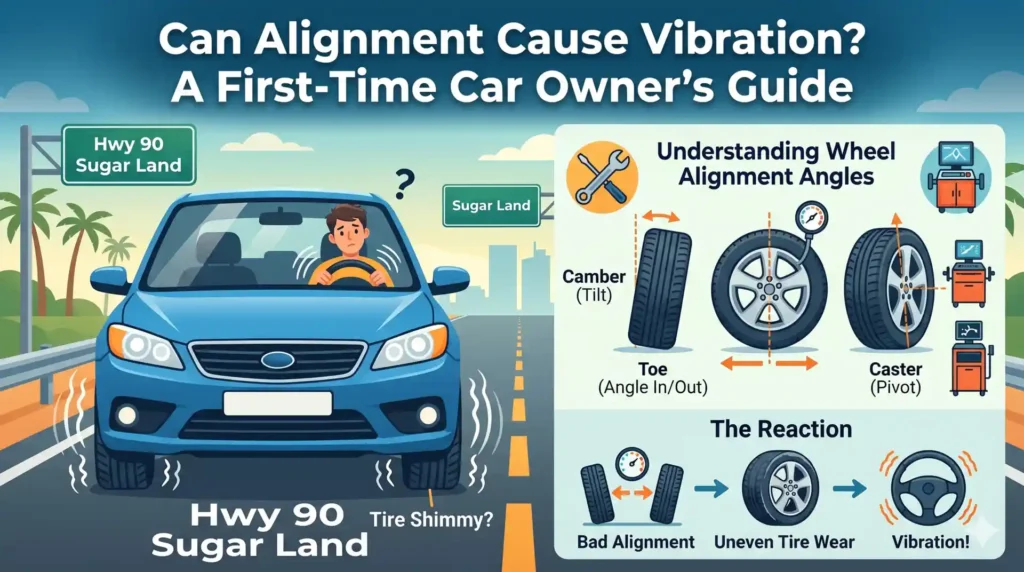
Wheel alignment refers to the angles at which your tires make contact with the road. When your alignment is correct, all four tires point in precisely the right direction, straight, level, and working together.
There are three main alignment angles every car has:
| Alignment Angle | What It Means | What Happens When It’s Off |
| Camber | The tilt of the tire inward or outward | Uneven tire wear on the inner or outer edge |
| Toe | Whether tires point inward or outward (like pigeon-toed feet) | Rapid tire wear, pulling to one side |
| Caster | The angle of the steering axis | Steering instability, pulling, wandering |
When any of these angles drift out of spec, from hitting a pothole, a curb, or just regular wear over time, your alignment is “off.”
Sugar Land roads, particularly around the First Colony area and US-59 feeder roads, are no strangers to rough patches and potholes that can knock alignment out faster than you’d expect.
So, Can Alignment Directly Cause Vibration?
Here’s where it gets a little nuanced, and where most articles online get it wrong for beginners.
Misaligned wheels don’t usually vibrate on their own. The angles themselves don’t spin or rotate, so they can’t directly create a vibration the way an unbalanced tire does.
But here’s the chain reaction that does create vibration:
Bad Alignment → Uneven Tire Wear → Vibration
When your alignment is off, your tires wear unevenly and faster than normal. One edge of the tire wears down while the other stays full. That uneven surface creates an imbalance as the tire rotates, and that imbalance is what you feel as a vibration.
Think of it like a washing machine drum that’s slightly warped. The machine itself isn’t broken, but the imbalance it creates makes everything shake.
💡 Pro Tip: If your tires are showing wear only on the inside or outside edge, not evenly across the tread, that’s a classic sign of an alignment problem. Check this by crouching down beside each tire and looking at the tread pattern.
Step-by-Step: How to Diagnose Whether Alignment Is Causing Your Vibration
Before you spend money at a shop, work through these steps first. This is the exact process a good mechanic uses to narrow down the cause.
Step 1: Notice When the Vibration Happens
The timing of your vibration is the single most useful diagnostic clue you have.
| When Does It Vibrate? | Most Likely Cause |
| At highway speeds (55–70 mph) | Tire balance, uneven tire wear, or alignment-related wear |
| When braking | Warped brake rotors, alignment is less likely |
| At low speeds or while idling | Engine or drivetrain issue, probably not alignment |
| During acceleration | Could be drivetrain, CV axle, or engine-related |
| Constant, regardless of speed | Tire issue or wheel bearing |
| Only when turning | CV axle or wheel bearing, not alignment |
Write down exactly when it happens. This one detail will save you time and money.
Step 2: Check Your Tire Tread for Uneven Wear
Get out of the car and physically look at each tire. What you’re looking for:
- Wear only on the outer edge: possible positive camber or toe-out issue
- Wear only on the inner edge: possible negative camber or toe-in issue
- Feathering (scalloped edges): common sign of toe misalignment
- Even wear across the whole tread: alignment is probably fine; look elsewhere
If you see uneven wear on one or more tires, you’ve likely found your connection to alignment.
Step 3: Check If Your Car Pulls to One Side
Drive on a straight, flat road (try the long stretch of Hwy 6 in Sugar Land). Loosen your grip on the wheel slightly. Does the car drift left or right on its own?
- Pulls consistently → Alignment is a likely contributor
- Drives straight → Alignment may be less of a factor in your vibration
Step 4: Check Tire Pressure
Before blaming alignment, eliminate the simplest cause. Low or uneven tire pressure creates the same vibration pattern as alignment-related wear, and it’s a free fix.
Check all four tires with a gauge. The correct pressure for your vehicle is on a sticker inside the driver’s door jamb, not on the tire sidewall (that number is the maximum, not the recommended pressure).
⚠️ Common Pitfall: Many first-time car owners skip tire pressure checks entirely and end up paying for an alignment when all they needed was air. In Sugar Land’s summer heat, tires lose pressure faster than in cooler climates. Check monthly.
Step 5: Look at Your Steering Wheel While Driving Straight
Is your steering wheel centered when you’re driving straight, or is it slightly tilted to one side?
A steering wheel that sits crooked while driving straight is one of the clearest signs of a wheel alignment problem. It means your alignment was corrected mechanically, but the steering wasn’t re-centered, or the alignment was never done properly.
Step 6: Get a Professional Alignment Check
If steps 1–5 point toward alignment, the next move is a professional alignment check. Most reputable auto shops in Sugar Land offer this service, and many will check alignment for free as part of a tire or service visit.
An alignment machine measures all three angles (camber, toe, caster) and compares them against your vehicle manufacturer’s specifications. If any angle is outside spec, the technician adjusts it.
What Does Alignment-Related Vibration Actually Feel Like?
First-time owners often wonder if what they’re feeling matches an alignment problem. Here’s how to describe it:
- A steering wheel wobble or shimmy: that gets worse as speed increases, usually between 55 and 70 mph
- A vibration you feel in the seat: rather than just the steering wheel (this typically means rear tires are involved)
- A drifting or wandering: feeling where the car doesn’t track straight without constant steering correction
- Vibration that gets worse over time: as tire wear progresses, alignment problems don’t fix themselves
Other Common Causes of Car Vibration (That Aren’t Alignment)
Here’s the honest truth: alignment is one cause, but it’s not the most common one. Before committing to an alignment, rule these out first.
Unbalanced Tires
This is the #1 cause of steering wheel vibration at highway speeds. A tire that’s slightly heavier on one side spins unevenly, creating a rhythmic shake, typically felt most at 60–70 mph.
Tire balancing is cheap (usually $15–$25 per tire in Sugar Land) and should be done with every tire rotation.
Worn or Damaged Tires
A tire with a flat spot, bubble, or internal belt separation will vibrate regardless of alignment. Run your hand along the tire surface and feel for unusual lumps or flat areas.
Brake Rotor Issues
If your vibration happens only when braking, the alignment almost certainly isn’t the cause. Warped brake rotors create a pulsing sensation through the brake pedal and steering wheel that feels very similar to alignment vibration, but only occurs when you press the brake.
Worn Suspension Components
Ball joints, tie rod ends, and control arm bushings wear out over time. When they do, they allow more play in the wheel than there should be. This extra movement can amplify any existing vibration, even if alignment and tire balance are correct.
Engine and Drivetrain Issues
If your vibration is felt throughout the whole car at low speeds, especially at idle, it’s likely not alignment at all. An engine misfire car shaking situation feels completely different from a tire or alignment vibration. Misfires create a rough, uneven shake that you feel even when sitting still.
Similarly, if you’re wondering why my truck shakes when I accelerate, that’s often a drivetrain issue, CV axles, U-joints, or driveshaft imbalance, not wheel alignment.
And if you’ve ever asked why does my car start shaking when parked, that points to an engine or idle issue entirely unrelated to alignment.
Alignment vs. Tire Balance: What’s the Difference?
This is one of the most common points of confusion for first-time car owners. They sound similar but fix completely different things.
| Wheel Alignment | Tire Balancing | |
| What it fixes | The angles at which tires contact the road | Uneven weight distribution in the tire/wheel |
| What causes it to go off | Potholes, curbs, wear over time | Normal driving, small road impacts |
| Symptoms | Pulling, uneven tire wear, crooked steering | Steering wheel shake at specific speeds |
| How often needed | Every 1–2 years or after a hard impact | Every tire rotation (every 5,000–7,500 miles) |
| Cost in Sugar Land | $80–$120 typically | $60–$100 for all four tires |
💡 Pro Tip: If you’ve never had either done and your car vibrates, start with tire balancing first. It’s cheaper, faster, and it’s more often the culprit for highway-speed vibrations than alignment is.
When Should You Get an Alignment in Sugar Land, TX?
Here’s a simple checklist. Get an alignment if:
✅ Your car pulls to one side consistently
✅ Your steering wheel is visibly off-center when driving straight
✅ Your tires show uneven wear on the edges
✅ You recently hit a large pothole or curb hard enough to feel it
✅ You’ve replaced a tire, strut, or suspension component
✅ It’s been more than 2 years or 25,000 miles since your last alignment check
You probably don’t need an alignment if:
- The vibration only happens when braking (that’s likely rotors)
- The vibration happens at idle or when parked (that’s likely engine-related)
- The vibration started immediately after a tire change (check balance first)
How Houston-Area Roads Affect Your Alignment
Living in Sugar Land and the greater Houston area puts extra stress on your alignment compared to drivers in other parts of the country. Here’s why:
- Expansion joints and road heaves: Common on local roads due to Houston’s clay soil shifting with seasonal moisture changes. These repeated small impacts gradually shift alignment angles.
- Pothole season: Heavy rainfall loosens road surfaces. One direct pothole hit can knock alignment out immediately.
- Heat cycles: Extreme summer temperatures cause rubber suspension bushings to degrade faster, which allows alignment angles to shift more easily.
- High traffic roads: Hwy 59, Hwy 90, and Hwy 6 feeder roads around Sugar Land have some of the roughest pavement in Fort Bend County.
If you’re driving these roads daily, checking alignment annually is a smart call, not just every two years.
Common Pitfalls First-Time Car Owners Make
❌ Getting an alignment when tires actually need balancing: Always balance first; it’s cheaper and more commonly the cause of vibration
❌ Ignoring uneven tire wear: Those edge-worn tires won’t fix themselves after an alignment; if wear is severe, you may also need new tires
❌ Assuming alignment fixes a vibration caused by brakes: If it only shakes when braking, get the rotors checked, not the alignment
❌ Skipping alignment after suspension repairs: Any time a suspension component is replaced, alignment needs to be rechecked. The geometry changes.
❌ Waiting too long: Bad alignment doesn’t just cause vibration; it destroys tires faster. A $100 alignment today can prevent a $600 tire replacement in six months.
Frequently Asked Questions
Q: Will an alignment fix my steering wheel vibration?
Maybe, but only if the vibration is caused by alignment-related tire wear. If your tires are still in good shape and evenly worn, balance is more likely the fix. Get a diagnostic check before committing.
Q: How long does an alignment take in Sugar Land?
Typically, 45 minutes to an hour at most local shops. Some offer same-day appointments.
Q: Can I drive with bad alignment?
Yes, but it’s costing you money every mile. Bad alignment eats through tires faster, reduces fuel efficiency slightly, and causes uneven wear that shortens tire life significantly.
Q: Does alignment affect ride quality?
Yes. Properly aligned vehicles track straighter, feel more stable, and put less stress on suspension components. Most drivers notice an immediate improvement after an alignment correction.
Q: How do I know if I need alignment or new tires?
If the existing tires are worn unevenly, you likely need both new tires and an alignment. Installing new tires without correcting alignment just destroys the new tires quickly.
Final Word: Start Simple, Then Diagnose Deeper
If your car is vibrating and you’re not sure why, don’t jump straight to alignment. Work through the steps in this guide:
- Note when the vibration happens
- Check tire pressure
- Look for uneven tire wear
- See if the car pulls to one side
- Rule out braking or engine-related vibration
- Get tires balanced first
- Then get an alignment check if the problem persists
Most first-time car owners in Sugar Land discover their vibration is a balancing issue, a quick, inexpensive fix. But if alignment is the root cause, catching it early protects your tires, your suspension, and your wallet.