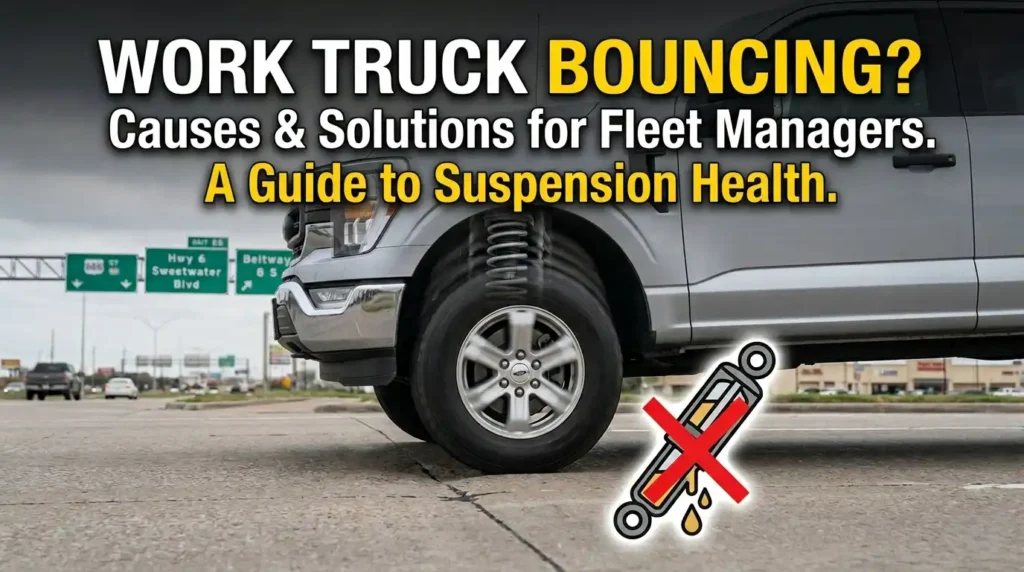
You’re heading down Hwy 6, crossing the tracks on Sweetwater Blvd, or navigating a job site parking lot in Sugar Land — and your car or truck feels more like a boat than a vehicle. Every bump sends the chassis bobbing. Corners feel floaty. The rear end sways on the highway.
For small business owners who rely on their vehicles every day — whether it’s a work truck, a service van, or a fleet of company cars — a bouncing, unstable ride isn’t just uncomfortable. It’s a sign that something in the suspension system is failing. And the longer it goes unaddressed, the more expensive the repair becomes.
This guide explains every cause of a car that feels like it’s bouncing, how to diagnose it step by step, and exactly what to do next — whether you’re managing one vehicle or a small fleet.
Table of Contents
ToggleWhat “Bouncing” Actually Means, And Why It Matters
A properly functioning suspension system keeps your tires in firm contact with the road at all times. It absorbs bumps, controls body motion, and maintains stable handling through corners and lane changes.
According to the principles behind suspension systems, the shocks and struts are specifically designed to dampen oscillation, meaning they stop the car from continuing to bounce after a bump. When they work correctly, the car settles after one controlled compression. When they don’t, the car keeps bouncing.
That continued bounce means your tires are periodically losing contact with the road. Less tire contact means less grip, longer braking distances, and reduced steering control in commercial and fleet vehicles carrying cargo or passengers; that translates directly to liability and safety risk.
The 7 Most Common Reasons Your Car Feels Like It’s Bouncing
1. Worn or Failed Shock Absorbers — The Primary Cause
This is the most common cause of a car that bounces excessively — by a wide margin.
Shock absorbers (and struts, which combine a shock with a structural suspension component) dampen the up-and-down motion of your vehicle after hitting a bump. When they wear out, they lose their ability to control that motion. The car continues to oscillate — bouncing multiple times after each bump instead of settling in one stroke.
What worn shocks feel like:
- Car continues to bounce 2–3 times after hitting a speed bump or pothole
- Rear end sways or rocks during highway lane changes
- Nose dives forward during braking
- Body rolls excessively in corners
- Ride feels “floaty” or disconnected from the road
Mileage to watch: Most shock absorbers begin losing effectiveness between 50,000–75,000 miles. Work trucks and vans that carry loads regularly often need them sooner — the added weight and road stress accelerates wear.
💡 Pro Tip: The quickest field test for worn shocks is the bounce test. Push down firmly on one corner of the car and let go. A healthy shock settles after one bounce. If the car continues to bob two or three times, those shocks are worn and need replacement.
2. Worn or Damaged Struts
Struts are the structural version of shock absorbers — found on the front suspension of most modern passenger cars and SUVs. When a strut wears out or its internal components fail, you get the same bouncing behavior as worn shocks, plus additional steering and alignment symptoms.
Signs of a failing strut:
- Bouncing and instability combined with steering vagueness
- Clunking or knocking sound from the front suspension over bumps
- Uneven tire wear on the front tires
- Car pulling to one side during braking
Sugar Land context: The road heave and rough surfaces on stretches of Hwy 90 and the older subdivision streets in First Colony and Telfair are particularly hard on struts. Repeated impacts from road irregularities gradually degrade strut performance even on vehicles with relatively low mileage.
3. Incorrect or Uneven Tire Pressure
Before assuming a suspension component, eliminate the simplest cause first.
Over-inflated tires have a smaller, stiffer contact patch with the road. The tire can’t flex properly to absorb small road irregularities, and every bump transmits directly into the chassis as a bounce or jolt. Under-inflated tires create their own instability — the sidewall flexes excessively and the vehicle can feel wallowing or soft.
What this feels like:
- Bouncy or harsh ride that seems to have appeared suddenly
- All four corners feel affected, not just one
- Ride improves or worsens noticeably after temperature changes
Houston/Sugar Land specific: Summer heat in the Houston area causes tire pressure to increase significantly — roughly 1 PSI for every 10°F rise in temperature. A tire correctly inflated at 32 PSI in the morning can read 36+ PSI after sitting in a Fort Bend County parking lot on a 100°F afternoon. That over-inflation directly creates a harsher, bouncier ride.
💡 Pro Tip: Check tire pressure when the tires are cold — before driving more than a mile. The recommended pressure is on the sticker inside the driver’s door jamb, not on the tire sidewall. For fleet vehicles, include tire pressure in your weekly pre-trip inspection routine.
4. Worn or Damaged Springs
Coil springs support the weight of the vehicle and work in tandem with the shocks or struts. When a spring weakens, sags, or breaks, the corner it supports drops lower than the others. This creates uneven ride height and causes the shock or strut at that corner to work at an angle it wasn’t designed for — producing bounce and instability.
Signs of a spring problem:
- One corner of the vehicle sits visibly lower than the others
- Bouncing that’s noticeably worse on one side of the car
- Clunking or banging sound over bumps from one specific corner
- Tire wear that’s uneven across the axle
Broken or sagged springs are more common on work vehicles and vans that are regularly loaded beyond their intended carrying capacity. If your service vehicle frequently carries heavy equipment or tools, spring condition is worth checking during every major service.
5. Damaged or Worn Bushings and Control Arms
Suspension bushings are rubber or polyurethane cushions that isolate metal suspension components from each other and from the vehicle frame. They allow controlled movement while absorbing vibration. When they crack, harden with age, or wear through completely, the suspension components they connect begin moving in ways they shouldn’t — creating a bouncy, unstable ride.
What worn bushings feel like:
- General instability and looseness in the suspension
- Clunking over rough roads that gets progressively worse
- Bouncing combined with a vague, wandering steering feel
- Vehicle feels unsettled on highway ramps and long sweeping curves
Houston-specific factor: Sugar Land’s summer heat and humidity age rubber bushings faster than in cooler climates. Vehicles parked outside — especially work vans and trucks that sit in direct sun all day — see bushing degradation at an accelerated rate. Inspecting bushings during suspension service is particularly important for Houston-area vehicles.
6. Overloaded Vehicle
This one is especially relevant for small business owners and fleet managers.
Every vehicle has a Gross Vehicle Weight Rating (GVWR) — the maximum weight it’s designed to carry, including passengers, cargo, and equipment. When a vehicle is consistently loaded above that rating, the suspension compresses beyond its designed range and shocks lose their ability to control motion effectively.
The result is a bouncy, wallowing ride that feels like the suspension is overwhelmed — because it is.
Common small business scenarios:
- Service vans loaded with tools, parts, and equipment that exceed the recommended payload
- Pickup trucks carrying lumber, supplies, or equipment past the rated bed capacity
- Delivery vehicles packed with product beyond their load rating
⚠️ Common Pitfall: Many small business owners in Sugar Land and Fort Bend County load their work trucks and vans based on what physically fits, not what the vehicle is rated to carry. Consistently overloading a vehicle doesn’t just cause bouncing — it accelerates wear on every suspension component simultaneously and can void warranty coverage on commercial vehicles.
7. Alignment Issues Compounding Suspension Wear
Wheel alignment doesn’t directly cause bouncing, but bad alignment wears tires unevenly and puts uneven stress on suspension components. Over time, the combination of misaligned wheels and worn components produces a ride that feels both bouncy and unstable.
If your car feels like it’s bouncing and also pulls to one side or has a steering wheel that sits off-center, alignment is likely contributing to the overall instability — even if it isn’t the primary cause.
Step-by-Step: How to Diagnose a Bouncing Car
Work through this process before booking a shop appointment. It saves time and helps your mechanic get straight to the repair.
Step 1: Identify When and Where the Bouncing Happens
| Bounce Pattern | What It Suggests |
| Bounces excessively after every bump | Worn shocks or struts |
| Bouncing only at highway speed | Tire pressure or balance issue |
| Bouncing worse on one corner | Worn shock or broken spring at that corner |
| Floating, wallowing feel overall | Shock absorbers at end of life |
| Bouncing with clunking sounds | Worn bushings, control arms, or strut mounts |
| Harsh jolt over small bumps | Over-inflated tires |
| Got worse after loading the vehicle | Overloaded suspension, weak springs |
Step 2: Do the Bounce Test
Park on level ground. Push down firmly on each corner of the vehicle one at a time, then let go. Count the bounces:
- 1 bounce, then settles → Shocks are likely okay at that corner
- 2–3 bounces before settling → Worn shock or strut at that corner
- Continues bobbing freely → Shock has failed — needs immediate replacement
Do this at all four corners and note which corners fail.
Step 3: Check Tire Pressure on All Four Tires
Use a gauge — don’t eyeball it. Check all four tires against the recommended pressure on the driver’s door jamb sticker. Correct any tires that are over or under-inflated.
If the bouncing improves noticeably after correcting tire pressure, that was the problem. If it doesn’t change, move to the next step.
Step 4: Visually Inspect Each Corner’s Ride Height
Stand back and look at the vehicle from the front and rear. Is it sitting level? Or is one corner visibly lower than the others?
A sagging corner indicates a weakened or broken spring. A broken spring is not a “drive carefully” situation — it needs same-week repair.
Step 5: Listen for Sounds Over Bumps
With the windows down on a quiet street:
- Clunking from one specific corner → Worn bushing, strut mount, or sway bar end link
- Knocking from the front → Worn strut mount or control arm bushing
- No sounds, just bounce → Shock absorbers worn but not yet mechanically failed
Step 6: Check Mileage and Service History
When were the shocks or struts last replaced? If the vehicle has over 60,000 miles and has never had suspension work, shocks and struts are the statistically most likely cause of a bouncy ride.
For fleet vehicles, track this in your service log. Shocks and struts replaced proactively at 60,000 miles cost far less than emergency suspension repairs caused by complete failure.
Step 7: Schedule a Professional Lift Inspection
If steps 1–6 point toward suspension components, a professional inspection on a lift is the definitive step. With the vehicle elevated and wheels hanging, a technician can individually test shocks, struts, springs, bushings, and control arms with precision.
Most Sugar Land auto shops can schedule a suspension inspection same-week.
Is a Bouncing Car Safe to Drive?
| Condition | Safety Level | What To Do |
| Mild bounce, all tires inflated correctly | Drive carefully to a shop within a week | Schedule suspension inspection |
| Moderate bounce with body sway on highway | Reduced safety — avoid highway driving | Book appointment within 2–3 days |
| Severe bouncing, one corner sagging | Not safe for highway or heavy loads | Get inspected immediately |
| Bouncing + clunking + vehicle pulling | Suspension component near failure | Do not load the vehicle — get it inspected today |
| Bouncing + vehicle feels out of control | Immediate safety risk | Pull over safely and call a tow |
For business vehicles carrying employees, customers, or cargo — the liability implications of driving a vehicle with a known suspension problem are significant. Document repairs promptly.
Why This Matters More for Small Business Owners in Sugar Land
If your vehicle is a business asset — whether it’s your personal work truck, a service vehicle, or part of a small fleet — a bouncing suspension has implications beyond just comfort:
Liability exposure: A vehicle that handles poorly is harder to control in an emergency. If a company vehicle is involved in an accident and inspection reveals known suspension wear, that becomes part of the liability picture.
Cargo damage: A bouncing delivery vehicle damages fragile cargo. If you’re transporting equipment, samples, or products across Fort Bend County, a worn suspension creates real product loss.
Employee safety: If your employees drive company vehicles, their safety depends on those vehicles being properly maintained. A van with blown shocks is measurably less safe at highway speeds on US-59 or Hwy 90.
Fleet longevity: Worn shocks and struts put stress on tires, wheel bearings, brake components, and every other suspension part. A $400 shock replacement today prevents a $1,500 multi-component repair in six months.
Texas state inspection: Work vehicles in Harris and Fort Bend County must pass annual state inspections. A vehicle with visibly sagging suspension or clearly failed struts may not pass.
Does a Bouncing Car Ever Point to an Engine Problem?
Sometimes what feels like suspension bouncing is actually engine-related. If your vehicle bobs or shakes at idle — even when parked — that’s not the suspension. That’s either an engine mount failure or an engine misfire.
A car shakes when starting and continues shaking at idle is almost always an engine or mounting issue, not a suspension problem. Similarly, engine misfire car shaking creates a whole-body vibration felt through the seat and steering wheel that can be mistaken for suspension bounce by newer drivers.
The key distinction: suspension bouncing happens in response to road inputs (bumps, turns, speed changes). Engine-related shaking happens regardless of road surface and is often felt even when the vehicle is completely stationary.
Houston-Area Roads That Accelerate Suspension Wear
Sugar Land and the greater Houston area are particularly hard on suspension components:
- Road heave from clay soil — Houston’s expansive clay soil swells and contracts with moisture, creating road heave and surface irregularities throughout Fort Bend County. Hwy 90, Hwy 6, and many Sugar Land subdivision streets develop surface undulations that repeatedly stress suspension components
- Post-flood road damage — Heavy rainfall events leave potholes and road damage that appear overnight. The stretch along US-59 near the Fort Bend/Harris County line sees new surface damage after nearly every major rain event
- Industrial and construction traffic — The significant industrial presence in the Houston-Katy-Sugar Land corridor means heavy truck traffic that accelerates road surface degradation on shared routes
- Heat — Sustained 95°F+ summer temperatures cause rubber bushings and shock absorber seals to degrade faster than in moderate climates
How Much Does It Cost to Fix a Bouncing Car in Sugar Land?
| Repair | Estimated Cost (Sugar Land/Houston Area) |
| Tire pressure correction | Free (check and fill at any gas station) |
| Tire rotation and balance | $60–$100 |
| Shock absorber replacement (pair) | $300–$700 |
| Strut replacement (pair, front or rear) | $400–$900 |
| Coil spring replacement (per pair) | $300–$600 |
| Control arm bushing replacement | $200–$500 |
| Control arm replacement | $300–$700 per side |
| Full suspension inspection on lift | Free–$75 at most shops |
💡 Pro Tip: Shocks and struts should always be replaced in pairs — both front or both rear at the same time. Installing one new shock next to a worn one creates uneven damping and handling that can actually make the ride worse than before the repair. For fleet vehicles, budgeting for axle-pair replacements keeps maintenance predictable.
Common Pitfalls Business Owners Make
❌ Delaying suspension repairs on fleet vehicles — Worn suspension accelerates tire wear, wheel bearing failure, and brake wear simultaneously. The deferred savings on one repair create three more
❌ Ignoring tire pressure in summer — Houston’s heat causes pressure to rise significantly during the day. Tires checked in the morning can be over-inflated by afternoon, creating a harsh, bouncy ride that gets blamed on suspension
❌ Overloading work vehicles — Consistently exceeding payload ratings accelerates shock and spring wear to a fraction of their rated lifespan
❌ Only replacing one shock when the pair is worn — Always replace in axle pairs
❌ Skipping the suspension inspection when buying a used work vehicle — Used trucks and vans used commercially often have worn suspension that isn’t obvious until you’ve driven them loaded
Frequently Asked Questions
Q: Can bad shocks cause tire wear on my work vehicles?
Yes, significantly. Worn shocks allow tires to bounce against the road surface irregularly, creating a “cupping” or “scalloping” wear pattern. This uneven wear shortens tire life dramatically and increases replacement costs on commercial vehicles.
Q: How often should shocks and struts be replaced on a work truck in Sugar Land?
Every 50,000–60,000 miles as a standard guideline, sooner if the vehicle carries loads regularly. Houston’s roads and heat often put vehicles at the lower end of that range.
Q: Can I drive my delivery van across Houston with worn shocks?
For short local trips to a shop, yes, carefully. For highway driving on US-59, I-10, or I-45 with a loaded vehicle, the handling compromise from worn shocks is a real safety risk. Get it inspected before running loaded highway routes.
Q: Will an alignment fix a bouncing car?
Not directly. Alignment corrects the angles at which your tires meet the road; it doesn’t fix worn shock absorbers or springs. However, if alignment problems have caused uneven tire wear that’s contributing to the bounce, both issues may need attention.
Q: Is a bouncing car more dangerous in rain?
Yes. Worn shocks mean tires spend more time losing contact with the road. On wet roads, which Houston sees frequently, that loss of contact dramatically increases hydroplaning risk and extends stopping distances.
Final Word: A Bouncing Car Is a Maintenance Problem, Fix It Before It Becomes a Safety Problem
For Sugar Land and Houston small business owners, a vehicle that feels like it’s bouncing isn’t just an annoyance. It’s a signal that the suspension components responsible for keeping your tires on the road are losing their ability to do their job.
Most causes- worn shocks, incorrect tire pressure, worn bushings- are straightforward repairs at any qualified local shop. Caught at the right time, they’re $300–$700 fixes. Ignored until failure, they become multi-component replacements that cost three times as much and take vehicles off the road at the worst possible time.
Work through the diagnostic steps, check the tires first, do the bounce test, and get a professional lift inspection if the source isn’t obvious. Your vehicles, your employees, and your bottom line will thank you.