So your mechanic just told you the engine mounts are worn out, and now you’re wondering if that’s even a real thing, how it happened, or whether you’re being upsold. You’re not alone. This is one of those car parts that most people never think about until something goes wrong.
Here’s the straightforward answer: most engine mounts last between 60,000 and 100,000 miles under normal driving conditions. But the real story is a bit more nuanced than that, and knowing the details could save you a costly repair down the road.
Let’s break it all down, plain and simple.
Table of Contents
ToggleWhat Is an Engine Mount, and Why Does It Matter?
An engine mount is a rubber-and-metal bracket that connects your engine to the car’s frame (called the subframe or crossmember). Most vehicles have two to four of them.
Their job is two-fold:
- Keep the engine physically in place so it doesn’t shift or slide while you drive
- Absorb vibration and noise so you don’t feel every little shake in your cabin
Without them, your engine would rattle around like a rock in a tin can. They’re the unsung heroes of a smooth, quiet ride.
Pro Tip: Engine mounts work alongside transmission mounts to stabilize your entire powertrain. If one set is worn, the other is usually not far behind — so always inspect both together.
How Long Do Engine Mounts Last? A Realistic Breakdown
The honest answer depends on several factors. Here’s a quick-reference table:
| Driving Condition | Expected Lifespan |
| Normal highway/city driving | 75,000 – 100,000 miles |
| Rough roads, potholes, off-road | 40,000 – 60,000 miles |
| Aggressive driving / frequent hard acceleration | 30,000 – 50,000 miles |
| Exposure to oil or fluid leaks | Significantly reduced |
| Extreme heat climates (like Sugar Land, TX) | Can accelerate rubber degradation |
The rubber inside a standard engine mount is designed to absorb shock — but rubber doesn’t last forever. Heat, oil exposure, and constant vibration slowly break it down over time.
What Shortens an Engine Mount’s Life?
Several things can cause engine mounts to wear out faster than expected:
- Oil or fluid leaks dripping onto the mounts — motor oil softens rubber and speeds up deterioration
- Aggressive acceleration and hard braking — especially common in stop-and-go traffic
- Sugar Land’s summer heat — sustained high temperatures in the Houston metro area can accelerate rubber aging faster than in cooler climates
- Potholes and rough road surfaces — every hard bump transfers stress directly into the mounts
- Overrevving or improper clutch use — particularly on manual transmission vehicles
6 Warning Signs Your Engine Mounts Are Failing
Don’t wait for your mechanic to tell you. Here’s what to watch for:
- Excessive Vibration While Idling: If your car feels unusually shaky when you’re sitting at a red light, the mounts may have lost their ability to absorb engine vibration. This is often the first sign people notice.
- A Clunk or Thud When Starting the Car: Notice a jolt or lurch when you turn the key? If your car shakes when starting, worn engine mounts are one of the most common culprits. The engine rocks more than it should during startup without proper support.
- Banging or Clunking Noises Under the Hood: A failing mount allows the engine to physically move and knock against surrounding components. That clunking noise isn’t something to ignore — the engine can actually make contact with other parts, causing additional damage.
- Vibration While Accelerating or Changing Gears: Feel a jolt every time you step on the gas or shift gears? That’s the engine torquing against a compromised mount. Sometimes people wonder if alignment can cause vibration — and while bad alignment can, engine mounts are worth ruling out first.
- Wheels Wobble Side to Side: In severe cases of mount failure, the excessive engine movement can cause unusual stress throughout the drivetrain, which may present as wheels wobble side to side — especially noticeable at low speeds.
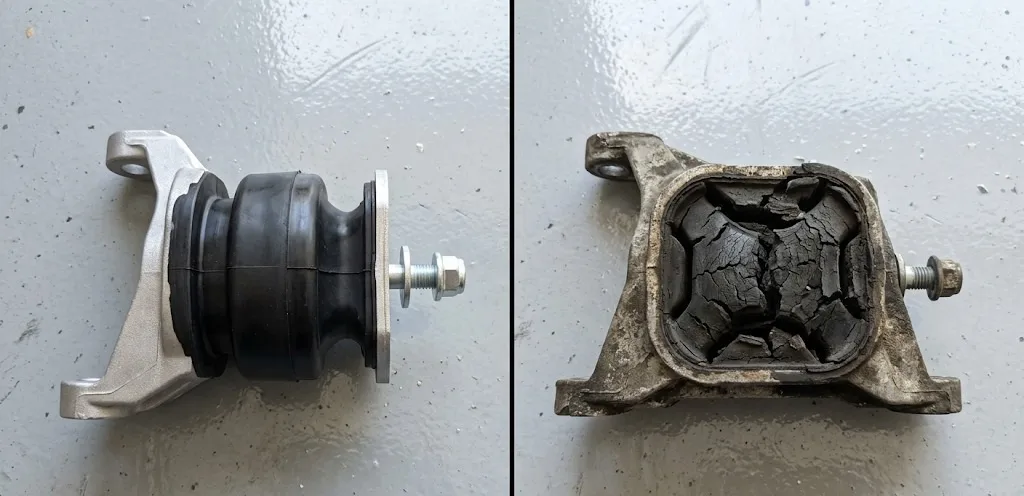
- Visible Cracks or Wear on the Mount: If your mechanic puts the car up on a lift and shows you the mount, here’s what bad looks like: cracked rubber, separation between the rubber and metal bracket, or a collapsed/compressed appearance.
Common Pitfall: Many drivers blame bad tires or alignment for vibration issues when the engine mounts are the real culprit. If you’ve already had your tires balanced and alignment checked, get the mounts inspected next.
What Happens If You Ignore Bad Engine Mounts?
Skipping this repair isn’t just uncomfortable — it’s potentially dangerous. Here’s what can happen over time:
- Engine misalignment — the engine shifts out of position, putting stress on hoses, belts, and other components
- Damage to the radiator and cooling hoses — the engine moving around can cause these to stretch or snap
- Accelerated wear on the transmission — especially if the transmission mount is also compromised
- In extreme cases, a fully broken mount — this can create a serious safety hazard, as the engine loses structural support entirely
The longer you wait, the more expensive the repair typically becomes.
How Much Does It Cost to Replace Engine Mounts in Sugar Land, TX?
Here’s what most Sugar Land drivers can expect to pay:
| Service | Estimated Cost Range |
| Single engine mount (parts only) | $50 – $150 |
| Labor per month | $150 – $300 |
| Full replacement (2-3 mounts, parts + labor) | $400 – $900+ |
| Dealership vs. independent shop | Dealerships typically run 20–40% higher |
Costs vary based on your vehicle make and model. European cars (BMW, Mercedes, Audi) tend to have higher parts costs. Domestic trucks and SUVs are often on the lower end.
Pro Tip for Sugar Land Drivers: Get at least two quotes before committing to a repair. Prices in the Greater Houston area can vary significantly between dealerships and independent mechanics. A good independent shop with solid reviews often does just as good a job for considerably less.
Should You Replace All Engine Mounts at Once?
This is one of the most common questions, and the answer is: not necessarily, but it’s worth discussing with your mechanic.
Here’s the logic:
- All your mounts are roughly the same age
- When one fails, the others take on extra stress to compensate
- If one has visibly deteriorated, the others are likely close behind
Replacing all mounts in one service visit saves on labor costs long-term. You only pay for one lift, one inspection, and one labor session rather than spreading it across multiple visits.
OEM vs. Aftermarket Engine Mounts: Which Should You Choose?
| Mount Type | Pros | Cons |
| OEM (Original Equipment) | Exact fit, tested for your vehicle, smooth ride | More expensive, may wear at the same rate as the original |
| Standard Aftermarket | More affordable, widely available | Quality varies by brand |
| Upgraded Polyurethane | Longer-lasting, more rigid support | May transmit slightly more vibration into the cabin |
For most everyday drivers in Sugar Land — commuting on I-69, running errands, and school drop-offs — a quality OEM or reputable aftermarket replacement will work perfectly. Upgraded polyurethane mounts are great if you want something that lasts longer and you don’t mind a slightly firmer ride.
Personal Insight: If you’re driving a vehicle with over 120,000 miles and planning to keep it for several more years, upgrading to higher-durability mounts is often worth the extra $50–$75 per unit. You get the peace of mind of not revisiting this repair anytime soon.
How to Make Your Engine Mounts Last Longer
You can’t stop rubber from aging, but you can slow the process:
- Fix fluid leaks promptly — oil dripping on rubber mounts is one of the fastest ways to accelerate wear
- Avoid aggressive acceleration from a stop, especially in a cold engine
- Get your vehicle inspected regularly — ask your mechanic to check the mounts as part of routine service every 30,000 miles
- Don’t ignore other drivetrain issues — a misfiring engine or rough idle puts more stress on mounts than a smooth-running one
- Park in the shade when possible — in Houston’s summer heat, minimizing UV and heat exposure helps preserve rubber components throughout your vehicle
Frequently Asked Questions
Can I drive with bad engine mounts?
You can, but you shouldn’t for long. Mild wear is manageable in the short term, but a severely damaged mount can cause further engine damage and become a safety risk. Get it inspected and repaired promptly.
How do I know if it’s the engine mount or something else causing vibration?
A good mechanic can visually inspect the mounts on a lift. They may also rev the engine while stationary and watch for unusual engine movement. The diagnosis is usually quick and inexpensive.
Do engine mounts need to be broken in?
No. New mounts are ready to go immediately. You may notice the ride feels slightly different for the first few days as everything settles — that’s normal.
Is this a DIY repair?
It can be, for experienced home mechanics with a floor jack and proper stands. However, it requires safely suspending the engine while swapping the mounts, which is not recommended for beginners. In Sugar Land, labor costs at independent shops are reasonable enough that most people opt for professional installation.
Final Thoughts
Engine mounts are a wear item, just like brake pads or tires. Most last between 60,000 and 100,000 miles, but Sugar Land’s heat, Houston-area road conditions, and your individual driving habits all play a role.
The moment you notice unusual vibrations, clunking sounds, or that familiar jolt at startup, get the mounts inspected. Catching this early is almost always cheaper than waiting until the damage spreads.
When in doubt, ask your mechanic to show you the mount during the inspection — a good shop will have no problem walking you through exactly what they’re seeing. That transparency is always a good sign that you’re dealing with someone you can trust.