Table of Contents
ToggleSomething Feels Off When You Drive. Could It Be Your Transmission?
You press the gas, leaving a light on Hwy 6, and the engine revs up, but the car takes a second to actually move. Or maybe you’re cruising on US-59 and the transmission suddenly seems to drop out of gear for a moment, then catches again.
That feeling has a name: transmission slipping.
For first-time car owners, it can be hard to describe, and even harder to know how serious it is. This guide explains exactly what slipping gears feel like in plain language, what causes it, how to diagnose it step by step, and what to do next if you’re in Sugar Land or the greater Houston area.
What Does Slipping Gears Actually Feel Like?
This is the question most articles skim over. Let’s answer it properly.
Transmission slipping doesn’t feel the same every time or in every vehicle. But here are the most common sensations drivers describe:
- The engine revs higher than normal, but the car doesn’t accelerate the way it should. You push the gas, and the RPM needle climbs, but the speed doesn’t follow. It feels like the power is going somewhere, just not to the wheels.
- A brief moment where the car feels like it’s in neutral. You’re moving, then for a split second, nothing, then the transmission catches, and you lurch forward slightly.
- Delayed response after pressing the gas. There’s a noticeable hesitation between your foot hitting the pedal and the car actually moving.
- Unexpected gear changes while driving. The car shifts up or down on its own without you doing anything, often accompanied by a brief surge or jerk.
- Loss of power on hills or when towing. The transmission slips most obviously under load, climbing an overpass, or pulling a trailer, making it much more apparent.
💡 Pro Tip: The single best description for transmission slipping is this: it feels like your car momentarily forgets what gear it’s in. The engine is doing its job, but the power isn’t transferring to the road the way it should.
What Do Slipping Gears Feel Like in Different Scenarios?
The feeling changes depending on when and where slipping happens. Here’s how to recognize it by situation:
| Scenario | What You Feel |
| Transmission slipping in 1st gear | Car hesitates or stumbles pulling away from a stop; engine revs, but acceleration is sluggish |
| The engine is slipping when accelerating | RPMs jump up sharply, but speed increase lags behind; it feels like a momentary loss of grip |
| Slipping during highway cruising | Transmission drops a gear unexpectedly, causing a small surge; cruise control may feel inconsistent |
| Slipping when shifting into Reverse | Delay before the car moves backward; clunk or jerk when reverse finally engages |
| Slipping under load (hills, towing) | Most obviously, power drops away noticeably; the engine works harder, but the car slows |
| Slipping at low speed in traffic | Subtle hesitation between gear changes; the car feels slightly jerky in stop-and-go |
Sugar Land’s stop-and-go traffic on Hwy 90, Hwy 6, and the US-59 corridor is particularly hard on transmissions. Repeated low-speed acceleration cycles put heavy demand on first and second gear engagement, which is exactly where slipping often starts.
Automatic vs. Manual Transmission: Does Slipping Feel Different?
Yes, and the distinction matters for diagnosis.
Automatic Transmission Slipping
According to automatic transmission mechanics, slipping in an automatic is typically caused by hydraulic pressure failures, worn clutch packs, or degraded transmission fluid. You don’t control gear changes, so slipping feels like the car making unexpected or delayed decisions on your behalf.
What it feels like in an automatic:
- Hesitation after pressing the accelerator
- RPMs climb without matching acceleration
- Unexpected downshifts or upshifts mid-drive
- Shuddering during gear changes
Manual Transmission Slipping
In a manual, slipping almost always comes from a worn clutch. You’ll feel it when you release the clutch pedal. Instead of a clean, positive engagement, the clutch disc slips against the flywheel before catching.
What it feels like in a manual:
- The clutch pedal feels higher or “mushier” than normal
- Engine revs spike when you release the clutch, but forward motion doesn’t match
- Burning smell, especially on hills or during aggressive driving
- The car barely moves, even with the clutch fully released
Step-by-Step: How to Diagnose Transmission Slipping
Work through these steps before calling a shop. This is the same process a good technician uses to narrow down the problem.
Step 1: Pay Attention to When It Happens
The most valuable information you can bring to a mechanic is when slipping occurs:
- Only from a stop? (1st gear issue)
- Only under hard acceleration? (fluid pressure or clutch issue)
- Only at highway speeds? (higher gear or torque converter issue)
- All the time, at every speed? (more serious, internal wear or fluid failure)
Write it down. Specific timing narrows the diagnosis dramatically.
Step 2: Check Your Transmission Fluid
This is the first physical check, and it’s free.
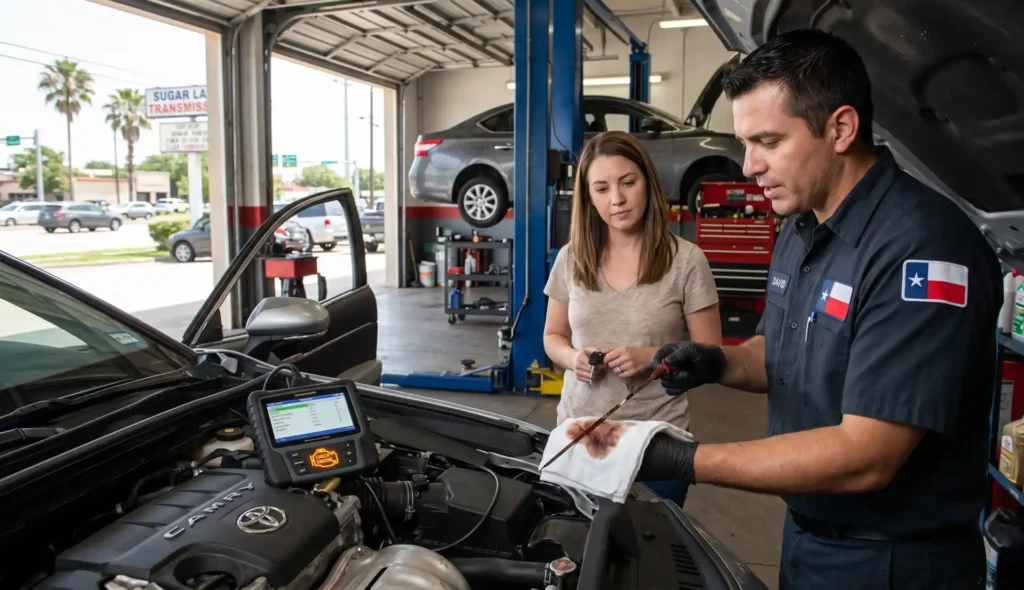
Locate the transmission dipstick (check your owner’s manual for the location; it varies by vehicle). With the engine warm and running, check:
Fluid Level:
- Low fluid is one of the most common causes of slipping in Sugar Land vehicles, especially during summer heat, when fluid expands and contracts repeatedly
- If the level is low, add the correct fluid type (specified in your owner’s manual), do NOT mix fluid types
Fluid Condition:
- Red or pinkish and clear → Good condition
- Dark brown or black → Degraded, needs a flush
- Milky or foamy → Coolant contamination, serious, stop driving
- Burnt smell when you wipe the dipstick → Fluid is overheated and breaking down
⚠️ Common Pitfall: Many first-time car owners don’t know their vehicle has a transmission dipstick, and some newer vehicles have sealed transmissions with no dipstick at all. If you can’t find it, check your owner’s manual or ask a shop to check it during any service visit.
Step 3: Check for Warning Lights
Does your check engine light come on when slipping occurs? Scan for fault codes at any AutoZone or O’Reilly location in Sugar Land, it’s free.
Common transmission-related OBD-II fault codes:
| Code | What It Means |
| P0700 | Transmission Control System fault |
| P0715 | Input/turbine speed sensor malfunction |
| P0720 | Output speed sensor malfunction |
| P0730 | Incorrect gear ratio detected |
| P0740 | Torque converter clutch circuit malfunction |
| P0750–P0770 | Shift solenoid faults |
💡 Pro Tip: A P0730 “incorrect gear ratio” code is one of the clearest electronic confirmations of transmission slipping. If you pull this code, bring it to a transmission specialist, not a general quick lube.
Step 4: Notice Any Accompanying Symptoms
Slipping rarely travels alone. Note whether you’re also experiencing:
- Shaking or vibration during acceleration: If you’re asking why does my truck shake when I accelerate, the answer could be tied to the transmission, particularly the torque converter or driveshaft
- Vibration or pulling: Sometimes what feels like transmission slipping is actually a drivetrain or suspension issue. If can alignment cause vibration has crossed your mind, rule out tire and suspension problems before assuming transmission
- Burning smell: Overheated transmission fluid or a slipping clutch
- Whining, humming, or clunking sounds: Internal transmission components under stress
- Delayed engagement from Park to Drive or Reverse: A strong signal of low fluid pressure or a worn solenoid
Step 5: Identify the Urgency Level
Not all slipping is equal. Here’s how to decide how fast to act:
| Severity | Signs | What To Do |
| Mild | Occasional slip from a stop; fluid is clean and full | Schedule service within 1–2 weeks |
| Moderate | Frequent slipping in multiple gears; fluid is dark | Book an appointment this week |
| Severe | Slipping in every gear; fluid is burnt or milky; warning lights | Stop driving, get it towed or diagnosed immediately |
Continuing to drive on a slipping transmission causes more damage exponentially. What starts as a fluid or solenoid issue can become a full internal clutch pack failure if ignored. In Houston’s heat, that progression happens faster.
6 Most Common Causes of Slipping Gears
1. Low or Degraded Transmission Fluid
This is the most common cause, and the most preventable.
Transmission fluid lubricates internal components and provides the hydraulic pressure that engages gears. When it’s low or broken down, clutch packs can’t grip properly, and gear engagement becomes inconsistent.
Houston’s summer heat degrades transmission fluid faster than in cooler climates. If you’ve never had your transmission fluid changed, and your vehicle has over 60,000 miles, this is the first place to look.
2. Worn Clutch Packs (Automatic) or Clutch Disc (Manual)
Inside an automatic transmission, clutch packs grip to hold gears in place. Over time and mileage, the friction material wears down, and grip becomes inconsistent. That inconsistency is what slipping feels like.
In a manual, the clutch disc simply wears thin and can no longer transfer engine power cleanly to the drivetrain.
3. Faulty Shift Solenoids
Solenoids control the flow of transmission fluid to engage each gear. When a solenoid sticks or fails electrically, it can cause delayed shifts, missed gears, or the transmission dropping out of gear unexpectedly.
This is a common cause of transmission slipping in 1st gear, specifically, the solenoid responsible for first gear engagement fails to hold pressure long enough for a clean launch from a stop.
4. Torque Converter Problems
The torque converter connects the engine to the transmission in automatic vehicles. When the torque converter clutch wears, or the converter itself starts to fail, you’ll feel a shudder, vibration, or slipping sensation, particularly at highway speeds or when the transmission locks up the converter during cruising.
5. Worn or Damaged Transmission Bands
Transmission bands wrap around drum components inside the transmission to hold gears. When they wear, stretch, or break, they can no longer hold a gear properly, and slipping follows. This is a more advanced internal repair, but it is diagnosable with a pressure test.
6. Valve Body Failure
The valve body is the hydraulic control center of an automatic transmission. It directs fluid to the correct circuits to engage each gear. When channels clog or valves stick, often from degraded fluid, gear engagement becomes sluggish, delayed, or inconsistent.
This is often what causes engine slipping when accelerating on otherwise well-maintained vehicles with adequate fluid levels.
What Happens If You Ignore Transmission Slipping?
This is worth being direct about.
A transmission that slips and is driven on will fail; it’s not a question of if, it’s when.
Here’s the progression:
- Minor slipping from worn fluid or a failing solenoid → $150–$400 fix
- Continued driving → clutch packs wear unevenly and overheat → $600–$1,500 repair
- More driving → internal components fail → full rebuild or replacement → $2,500–$5,000+
In Sugar Land’s heat, where transmission fluid degrades faster, and stop-and-go traffic puts more stress on low-speed gear engagement, that progression moves quicker than in cooler climates.
💡 Pro Tip: A transmission fluid service (drain and refill or flush) typically costs $100–$200 in Sugar Land. That same $150 spent early can prevent a $3,000 transmission rebuild later. It’s one of the most cost-effective preventive maintenance items on any vehicle.
Transmission Slipping vs. Other Problems That Feel Similar
Not every hesitation or vibration is a transmission issue. Here’s how to tell the difference:
| Symptom | Transmission Slipping | Other Possible Cause |
| The engine revs, but the car doesn’t accelerate | Yes, classic slipping | Slipping clutch (manual), low tire pressure |
| Vibration during acceleration | Possible torque converter | Engine misfire, CV axle, driveshaft imbalance |
| Hesitation at a stop | Yes, especially 1st gear slip | Spark plugs, fuel delivery, throttle body |
| Jerking or lurching between gears | Yes, worn bands or solenoids | Engine misfire, rough idle |
| Pulling to one side | Unlikely | Alignment or brake issue |
| Shaking at highway speed | Possible converter shudder | Tire balance, suspension wear |
Houston-Specific Factors That Accelerate Transmission Wear
Living and driving in Sugar Land adds real-world stress to your transmission that drivers in cooler states don’t face:
- Heat: Transmission fluid breaks down faster at sustained high temperatures. Houston summers push under-hood temps well above what most vehicles were designed to handle daily
- Stop-and-go traffic: Hwy 6, Hwy 90, and the US-59 Southwest Freeway put repeated demand on 1st and 2nd gear engagement, exactly where slipping starts
- Towing culture: Many Sugar Land and Fort Bend County residents use trucks for towing boats, trailers, or equipment. Towing accelerates transmission wear faster than any other driving style
- Deferred maintenance: Texas doesn’t require emissions checks for vehicles over a certain age in some counties, which means fluid services sometimes get skipped longer than they should
Common Pitfalls First-Time Car Owners Make
❌ Waiting until the transmission fully fails before getting it checked: Slipping that’s caught early is almost always a minor repair
❌ Adding the wrong type of transmission fluid: Using the wrong fluid can cause more damage than having low fluid. Always check your owner’s manual for the exact specification
❌ Confusing a misfire for transmission slipping: Both create hesitation and stuttering. A free OBD-II scan will quickly distinguish between the two
❌ Ignoring a burning smell: Burnt transmission fluid is your transmission telling you it’s overheating. This needs immediate attention
❌ Continuing to drive hard on a slipping transmission: Every hard acceleration on a slipping transmission accelerates internal wear. Drive gently and get it diagnosed
Frequently Asked Questions
Q: Is transmission slipping dangerous to drive on?
Mild slipping is drivable for a short distance, to a shop. Severe slipping, especially with burning smell, warning lights, or fluid loss, is not safe to drive on. You risk full transmission failure and loss of power at a critical moment.
Q: How much does it cost to fix a slipping transmission in Sugar Land?
Fluid service: $100–$200. Solenoid replacement: $250–$600. Clutch pack repair: $800–$1,500. Full rebuild: $2,500–$5,000+. Early diagnosis is always the cheapest option.
Q: Can I fix transmission slipping myself?
Topping up fluid, yes, if you use the correct type. Anything beyond that requires professional equipment and expertise. Don’t attempt internal transmission work without proper training.
Q: Does transmission slipping get worse over time?
Yes, always. It never resolves on its own. The longer slipping is ignored, the more internal components wear, and the more expensive the repair becomes.
Q: How often should transmission fluid be changed in Houston?
Most manufacturers recommend every 30,000–60,000 miles for conventional fluid, or up to 100,000 miles for full synthetic. In Houston’s heat and stop-and-go conditions, staying at the lower end of that range is the smarter call.
Final Word: Slipping Gears Is Your Transmission Asking for Help
That hesitation, that rev-without-movement, that brief moment where your car forgets what gear it’s in, those aren’t quirks. They’re warning signals from one of your vehicle’s most expensive systems.
The good news is that most transmission slipping, caught early, is fixable without a full rebuild. Low fluid. A failing solenoid. Worn fluid that needs a flush. These are $100–$400 repairs, not $4,000 ones.
If you’re in Sugar Land or Houston and you’re feeling any of the symptoms described in this guide, get a diagnostic done before your next tank of gas runs out. A quick fluid check and OBD-II scan will tell you everything you need to know to make a smart, informed decision.
Experiencing transmission slipping in Sugar Land or Houston, TX? Don’t wait for a minor fix to become a major repair. Schedule a diagnostic with a trusted local transmission specialist today.