
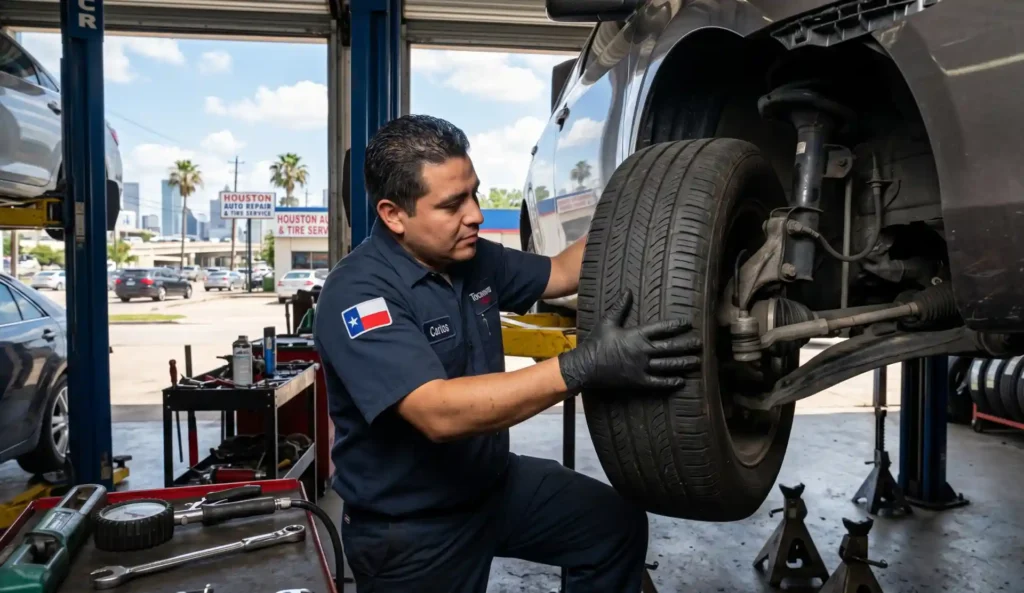
You’re driving down Hwy 6 or merging onto I-10, and you feel it, a side-to-side rocking, a shimmy through the steering wheel, or a wobble so bad it feels like the whole front end is trying to shake loose.
A wheel that wobbles side to side is a completely different animal from ordinary road vibration. And for first-time car owners, fleet managers, or anyone who uses their vehicle for work, it can be hard to know whether this is a minor fix or a reason to pull over immediately.
This guide walks you through every possible cause, how to diagnose it yourself step by step, and exactly what to do next, whether you’re a weekend DIYer or heading straight to a shop in Houston.
Table of Contents
ToggleSide-to-Side Wobble vs. Up-and-Down Vibration: Know the Difference
Most articles online lump all wheel wobbles into one category. They shouldn’t, because the direction of the movement tells you a lot about the cause.
| Type of Movement | What It Feels Like | What It Usually Points To |
| Side-to-side wobble | The wheel rocks left and right; the steering wheel oscillates | Loose wheel bearing, worn tie rods, loose lug nuts, bent wheel |
| Up-and-down bounce | Car hops or bounces over bumps more than normal | Worn shocks or struts |
| Rotational vibration | The steering wheel shakes at specific speeds | Tire imbalance, alignment-related tire wear |
| Severe side-to-side at speed | Violent, uncontrollable shaking above 45 mph | Death wobble — serious suspension failure |
If your wheel is genuinely rocking side to side, not just vibrating — the causes are specific, and some of them are urgent. Keep reading.
7 Reasons Your Wheels Wobble Side to Side
1. Worn or Failing Wheel Bearing, The Most Common Cause
A wheel bearing allows your wheel to spin freely and smoothly on the axle. When a bearing wears out, it develops “play” — loose movement that allows the wheel to rock laterally on the hub.
This is the most common mechanical cause of true side-to-side wheel wobble. And it’s a safety issue, not just a comfort issue.
What it feels like:
- The wheel visibly wobbles or rocks if you grab it at the 9 o’clock and 3 o’clock positions and push and pull
- Humming or grinding noise from the affected wheel that gets louder with speed
- The noise may change pitch when you change lanes (shifting weight off the bad bearing temporarily relieves it)
- Wobble worsens gradually over weeks or months
What makes this common in Houston: Heat and humidity accelerate bearing seal degradation. Houston’s flooding events also introduce moisture and contamination into wheel bearings on vehicles driven through high water, something Texas drivers deal with more than most.
⚠️ Common Pitfall: A failing wheel bearing is not a “monitor it” situation. A bearing that fails completely at highway speed on I-45 or Beltway 8 can cause the wheel to seize or detach. If you hear grinding and feel side-to-side wobble, get it checked immediately.
2. Loose or Improperly Torqued Lug Nuts
This one sounds simple, and it is. But it’s also one of the most dangerous causes of wheel wobble.
If lug nuts are not tightened to the correct torque specification after a tire change or rotation, the wheel can develop side-to-side play as it loosens over time. The wobble starts subtly and grows quickly.
What it feels like:
- Wobble that appeared shortly after a tire change, rotation, or brake service
- Side-to-side rocking that gets noticeably worse in just a few days
- Clicking or clunking sound from the affected wheel
Check this first if the wobble started after any recent wheel service. Pull over safely, check whether the wheel wobbles by hand (engine off, in Park), and visually inspect whether any lug nuts are visibly loose.
💡 Pro Tip: After any tire service in Houston, drive carefully for the first 25–50 miles and then re-check that the lug nuts are still tight. Some shops skip the final torque check — this is a simple way to catch a potentially catastrophic problem early.
3. Worn Tie Rod Ends
Tie rods connect your steering rack to the steering knuckle at each front wheel. When the tie rod end wears out, it develops excessive play — allowing the wheel to move side to side independently of your steering input.
This is one of the most common causes of front wheel wobble at low to moderate speeds, and it’s especially prevalent on higher-mileage vehicles.
What it feels like:
- Side-to-side wobble primarily at lower speeds (15–45 mph)
- Steering wheel feels loose or wanders, the car doesn’t track straight without active correction
- Clunking over bumps from the affected corner
- Uneven or rapid tire wear on the affected side
If alignment causes vibration has crossed your mind while dealing with a front-end wobble, worn tie rods are frequently the root cause. Bad tie rods throw alignment angles off, which then causes uneven tire wear, which then creates vibration on top of the original wobble.
⚠️ Common Pitfall: Many drivers get an alignment done to fix a wobbly, wandering front end, only to find the car pulls again within weeks. If the tie rod ends are worn, alignment can’t be maintained. The tie rods must be replaced before alignment is performed.
4. Worn Ball Joints
Ball joints connect the steering knuckle to the control arm and allow the wheel to pivot during steering and suspension travel. When they wear out, they allow lateral movement in the wheel, meaning the wheel can rock side to side beyond its designed range of motion.
This is particularly common on trucks, SUVs, and higher-mileage vehicles in the Houston area.
What it feels like:
- Side-to-side wobble that’s worst on rough roads or when turning
- Clunking or popping from the front suspension over bumps
- Vehicle pulls to one side, especially under braking
- In severe cases, the steering feels vague and imprecise
The safety risk: A ball joint that fails completely causes the wheel to collapse inward. This results in immediate loss of steering control. On Houston’s highways, I-45, US-59, or the Sam Houston Tollway — this is a life-threatening situation.
5. Bent or Damaged Wheel (Rim)
Hitting a pothole hard enough, and Houston has no shortage of those, especially after heavy rain on roads like Hwy 290 or surface streets in the Heights, can bend a wheel rim. A bent rim creates an out-of-round rolling surface that causes the wheel to wobble laterally as it rotates.
What it feels like:
- Wobble that started immediately after hitting a pothole or curb
- Vibration that’s present at all speeds, not just one specific range
- May also hear a rhythmic thumping from the affected wheel
- The tire may lose pressure repeatedly (a bent rim breaks the bead seal)
Check it yourself: Look at the rim from directly in front of the vehicle while someone slowly rolls the car forward. Watch whether the rim tracks perfectly straight or wobbles as it rotates. Even a small visible wobble indicates a bent wheel.
6. Damaged or Separated Tire
Physical tire damage causes a specific type of wobble that mimics mechanical suspension failure — and can fool even experienced drivers.
Internal belt separation is particularly dangerous. When the steel belts inside a tire separate from the carcass, the tire develops an irregular shape that makes the wheel appear to wobble side to side as it rolls.
What to look for:
- Visible bulge or bubble on the sidewall or tread surface
- Wobbles that appeared suddenly, often after driving over road debris
- A thumping sound that matches the wheel rotation speed
- Vibration present even at very low speeds (5–15 mph)
The Houston risk: Construction zones around the Energy Corridor, Northwest Houston, and the ongoing I-69/US-59 expansion projects leave road debris on feeder roads that can puncture or damage tires without the driver even noticing.
💡 Pro Tip: If your wheel started wobbling after driving through a construction zone or over road debris, inspect the tire before assuming it’s a mechanical problem. Run your hand around the full circumference of each tire — a belt separation creates a detectable lump even if it’s not visible.
7. The “Death Wobble”, Especially on Trucks and Lifted Vehicles
If you drive a truck, SUV, or lifted vehicle and experience a sudden, violent side-to-side shaking that seems to take over the entire front end, usually above 45 mph, you may be experiencing what’s commonly called the death wobble.
This is not a single-component failure. It’s a resonance phenomenon where multiple worn front-end components, typically a combination of worn tie rod ends, ball joints, track bar, or steering stabilizer, reach a critical state where vibration amplifies uncontrollably.
What it feels like:
- Suddenly, severe side-to-side shaking of the steering wheel and front end
- Often triggered by a bump, pothole, or lane change at speed
- The vehicle may feel temporarily uncontrollable
- Slowing down typically makes it stop
Houston context: This is extremely common among Houston-area truck and lifted SUV owners, particularly those driving Jeep Wranglers, Ford F-250/F-350s, and Ram 1500/2500s with lift kits. The combination of Houston’s rough roads, heavy truck culture in Fort Bend and Harris County, and the popularity of suspension lifts creates ideal conditions for death wobble development.
If you’re asking what slipping gears feels like alongside a violent front-end wobble on your truck, those are two separate systems, both signaling that your vehicle needs immediate professional attention.
Step-by-Step: How to Diagnose Wheels Wobbling Side to Side
Work through these steps before spending money. This is the same process a good technician uses.
Step 1: Identify When and Where the Wobble Happens
Answer these questions first:
- At what speed does it start? Low speed (under 40 mph) points more to bearing or tie rod issues. Higher speeds point to balance or bent wheel.
- Is it constant or triggered? Does it happen smoothly or suddenly after hitting a bump? Sudden onset at speed = possible death wobble.
- Front wheels only or all four? Front wobble = steering/suspension. Rear wobble = bearing or axle issue.
- Did it start after the recent service? Wheel change, rotation, or brake work? Check lug nuts immediately.
Step 2: The Manual Wobble Test
With the car safely parked, engine off, and in Park or with chocks behind the rear tires:
- Grab the tire at the 9 o’clock and 3 o’clock positions (sides) and push and pull firmly
- Now grab at 12 o’clock and 6 o’clock (top and bottom) and push and pull
What the results mean:
| Movement Found | Most Likely Cause |
| Side-to-side play (9 & 3 test) | Worn tie rod ends or loose wheel bearing |
| Up-and-down play (12 & 6 test) | Worn ball joints or wheel bearings |
| Play in both directions | Multiple worn components need immediate shop inspection |
| No movement | Bearing and joints are likely okay; look at the tire/wheel |
Step 3: Visual Wheel Inspection
Have someone slowly roll the car forward while you watch each wheel from directly in front:
- Does the wheel track perfectly straight, or does it wobble as it rotates?
- Look for any visible bends, cracks, or damage on the rim
- Check each tire for bulges, bubbles, or irregular tread
Step 4: Check Lug Nuts
Using a torque wrench (or asking a shop to verify), confirm all lug nuts are tightened to spec. Your owner’s manual lists the correct torque value, typically 80–120 ft-lbs for most passenger vehicles and 120–150 ft-lbs for trucks.
Step 5: Listen While Driving (Safely)
On a quiet street at low speed, roll down the windows and listen:
- Grinding or humming that increases with speed → wheel bearing
- Clunking over bumps → ball joint or tie rod end
- Rhythmic thumping → flat spot or belt separation in tire
- No sound, just wobble → bent wheel or out-of-balance tire
Step 6: Get a Professional Lift Inspection
If steps 1–5 point toward suspension components, a shop inspection on a lift is the definitive next step. With the vehicle elevated and the wheel hanging freely, a technician can test each component individually with far more precision than any driveway test allows.
Most reputable Houston-area shops offer free or low-cost suspension inspections, especially if you’re already bringing the vehicle in for another service.
When Is a Side-to-Side Wobble a Safety Emergency?
| Severity | Signs | What To Do |
| Monitor | Mild wobble at low speed; no noise; started recently | Schedule an inspection within a week |
| Soon | Wobble at multiple speeds; humming sound present | Book a shop appointment within 2–3 days |
| This week | Visible play in manual test; steering feels loose | Don’t delay — suspension component worn |
| Today | Wobble started after hitting a pothole; the tire has a bulge | Inspect the tire immediately; don’t drive at speed |
| Stop driving | Violent side-to-side shaking at highway speed; sudden onset | Pull over safely; do not drive further |
How Much Does It Cost to Fix Wheel Wobble in Houston?
| Repair | Estimated Cost in Houston |
| Wheel bearing replacement (per wheel) | $250–$500 |
| Tie rod end replacement (per side) | $150–$400 |
| Ball joint replacement (per joint) | $200–$500 |
| Wheel rim replacement | $100–$400 depending on size/style |
| New tire (mid-range, per tire) | $120–$200 |
| Steering stabilizer (trucks) | $80–$200 parts + labor |
| Full front-end inspection | Free–$50 at most Houston shops |
💡 Pro Tip: If multiple front-end components are worn, many Houston shops will offer a package price for replacing tie rods, ball joints, and an alignment together. Bundling these repairs saves money compared to fixing them one at a time.
Houston-Specific Factors That Accelerate Wheel Wobble
Living and driving in Houston creates specific conditions that wear front-end components faster than in many other cities:
- Potholes and road heave — Houston’s clay-heavy soil expands and contracts with moisture, creating road heave and potholes that hit front-end components hard. Roads around Hwy 290, Hwy 59 feeders, and inner-loop surface streets are especially rough
- Flooding — Driving through standing water — unavoidable in Houston — introduces moisture into wheel bearings, accelerating corrosion and wear
- Construction debris — The constant road construction around the Energy Corridor, Katy, and Sugar Land leaves metal debris, concrete chunks, and other hazards that damage tires and bent rims
- Truck and lifted vehicle culture — Fort Bend County and Harris County have among the highest concentrations of lifted trucks in Texas. Lift kits change suspension geometry in ways that accelerate wear on tie rods, ball joints, and track bars — particularly on vehicles driven on rough Houston roads
- Heat — 95°F+ summer temperatures accelerate rubber bushing degradation throughout the suspension system
Common Pitfalls to Avoid
❌ Ignoring a wobble because “the car still drives” — Worn ball joints and wheel bearings don’t announce when they’re about to fail completely. They fail suddenly
❌ Getting an alignment to fix a wobble without checking suspension first — If ball joints or tie rods are worn, alignment won’t hold. Fix the worn components first
❌ Driving a truck with a death wobble on Houston highways — At 65 mph on I-10, a death wobble episode can cause loss of control. This is not a “drive carefully until the appointment” situation
❌ Assuming a bubbled tire is safe to drive on — A tire with internal belt separation can fail without warning. Replace it before driving at speed
❌ Skipping the lug nut check after any wheel service — It takes 90 seconds and can prevent a wheel from coming off at speed
Frequently Asked Questions
Q: Is a side-to-side wheel wobble dangerous?
It depends on the cause, but most causes of true side-to-side wobble are serious. Loose lug nuts, failing wheel bearings, and worn ball joints are all safety-critical issues. Don’t delay getting it diagnosed.
Q: Can a tire imbalance cause a side-to-side wobble?
Tire imbalance more commonly causes a rotational vibration rather than a true lateral wobble. If the wheel is rocking noticeably from side to side, imbalance alone is rarely the cause; look at bearing, tie rod, or lug nut issues first.
Q: How long can I drive with a wobbly wheel in Houston?
For mild wobble with no noise and no play detected in the manual test, carefully and briefly, to reach a shop. For wobbles with grinding, play detected by hand, or violent shaking at speed, do not drive. Call a tow.
Q: My truck wobbles violently above 50 mph. Is that the death wobble?
Quite possibly. Especially on lifted trucks or Jeeps. Reduce speed immediately, drive to a shop, and have the entire front-end steering and suspension system inspected. Do not drive at highway speeds until it’s resolved.
Q: Will wheel alignment fix a side-to-side wobble?
Not on its own. Alignment corrects tire angles; it doesn’t fix worn mechanical components. If tie rods or ball joints are causing the wobble, alignment must come after those are replaced.
Final Word: A Wobbling Wheel Needs a Real Answer, Not a Wait-and-See
A wheel that wobbles side to side is your car communicating something specific. Unlike a mild vibration that can wait a few days, a true lateral wobble involves components that are either dangerously loose or wearing toward failure.
Work through the diagnostic steps in this guide. Check for play at the wheel, listen for sounds, and note when it happens. Then take that information to a trusted Houston-area shop and get a proper lift inspection.
The fix is almost always straightforward: a bearing, a tie rod, a bent rim. What makes it expensive is waiting too long.